1. Dog Carrier Backpack and Dog Sling Carrier: Define the Two Designs
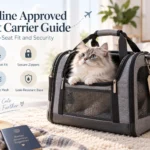
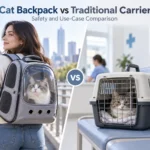
A dog carrier backpack uses a dual-shoulder frame design to distribute gravitational pet weight symmetrically across the human torso. Sourcing or manufacturing a reliable dog carrier backpack requires precise structural load balancing to prevent operator fatigue during active urban movement. Factory pattern pieces must integrate padded shoulder harnesses, lumbar support panels, and rigid internal back support plates. Understanding overall carrier safety and design principles is essential before selecting a specific format. Our best dog carrier bag guide covers key factors including fit, comfort, and structural performance. These components transfer the live animal load directly down to the wearer’s hips instead of straining the upper spine. Engineering proper load transfer protects brand portfolios from high customer return rates due to operator discomfort while optimizing the performance of a dog sling carrier.
-
Primary Question: How does a dual-shoulder frame alter wearer ergonomics compared to single-strap alternatives?
-
Direct Answer: A dual-shoulder frame distributes gravitational pet weight symmetrically across the human torso and transfers loads directly to the wearer’s hips.
-
Complementary Explanation: Factory engineering integrates padded harnesses, lumbar panels, and rigid back plates to relieve upper spine strain during active urban mobility.

2. Quick Comparison by Use Case, Pet Size, and Trip Duration
Short urban commutes require minimalist soft-goods that allow rapid pet loading and unloading inside crowded public transit networks. Navigating packed subway grids with a dog carrier backpack or pet carrier backpack demands a sleek, low-profile footprint equipped with quick-zip side loading, whereas backcountry treks require hydration routing, fold-flat bowls, and a rigid skeletal frame for marathon comfort. Floor engineers pivot between these builds by hot-swapping hardware layouts and pocket specs while keeping the master chassis entirely untouched. Matching product configurations to specific trip durations ensures optimal retail sell-through rates across diverse distribution channels while accommodating a lightweight dog sling carrier.
| Use Case Parameter | Short Urban Commute | Extended Travel Journey |
| Structural Profile | Compact, low-profile collapsible chassis | Multi-compartment reinforced touring frame |
| Access Portals | Rapid-access side and top entry zippers | Multi-point loading with expansion pockets |
| Internal Support | Semi-rigid EVA base foundation | Multi-ply composite floor with lumbar bracing |

3. When Dog Carrier Tote Is the Better Choice
A structured dog carrier tote offers unmatched fashion aesthetics and effortless side-loading access for social environments like upscale retail centers. However, totes present inherent balance limitations because the entire gravitational load hangs from a single human shoulder joint. Sourcing a dependable dog carrier tote requires internal tether integration to prevent agile pets from leaping out of open-topped configurations. Brand developers must communicate proper usage guidelines to prevent consumer misuse and accidental animal falls during transit. Balancing aesthetic appeal with rigorous safety features defines premium manufacturing execution alongside any dog carrier backpack.
-
Primary Question: What are the primary performance trade-offs of a traditional pet transport tote?
-
Direct Answer: Totes offer superior fashion aesthetics and rapid side-loading access, but present single-shoulder balance limitations.
-
Complementary Explanation: Internal tether integration is mandatory to prevent agile pets from leaping out, balancing open-topped convenience with essential containment security.

4. Size, Fit, and Load Distribution
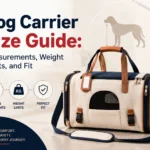
Accurate spatial specifications must calculate interior usable volume rather than relying on deceptive exterior fabric measurements. Sourcing any precision backpack pet carrier for dogs requires evaluating internal length, width, and height clearances with cushioning installed. Factory pattern engineers account for internal foam padding thickness to ensure that listed pet weight limits match real-world comfort. Proper sizing calculations are essential for pet comfort and safety. Our dog carrier size guide explains how measurements, weight limits, and fit affect overall carrier performance. Overlooking internal volumetric loss leads to cramped enclosures and negative customer reviews. Precise spatial auditing guarantees that retail buyers receive exact performance parameters that rival any premium dog carrier backpack.
| Spatial Metric | Deceptive Exterior Dimension | Precision Usable Interior Volume |
| Length Clearance | Measured from outer seam to seam | Reduced by 15mm for internal foam padding |
| Width Capacity | Outer fabric panel perimeter | Constrained by rigid frame insert thickness |
| Height Allowance | Total vertical height from base | Adjusted for safety tether clearance and mesh headroom |

5. Safety, Ventilation, and Escape Prevention
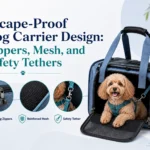
Impenetrable animal containment requires self-locking zipper sliders, interior safety tethers, and vinyl-coated steel mesh panels. An active dog shoulder carrier must withstand aggressive scratching and biting from high-anxiety pets without tearing. Factory production protocols apply heavy bar-tacking across all tether attachment points and zipper terminal stops. Integrated metal swivel clips attach directly to standard harnesses in the escape-proof dog carrier to prevent accidental leaps during sudden environmental startles. Rigorous mechanical safety standards protect brands from liability and ensure absolute animal security across every dog carrier backpack specification.
-
Primary Question: What mechanical features prevent animal escape during sudden startles?
-
Direct Answer: Self-locking zipper sliders, heavy-duty interior tethers, and vinyl-coated steel mesh prevent accidental escapes.
-
Complementary Explanation: Factory bar-tacking secures tether anchor points, while metal swivel clips attach directly to harnesses to withstand aggressive scratching and biting.

6. Materials, Cleaning, and Long-Term Durability
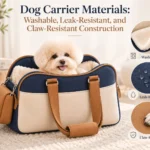
Building a bulletproof dog purse carrier or dog carrier backpack starts by fusing 1680D ballistic nylon shells with waterproof PEVA liners and high-density EVA foam. Factory lamination rigs heat-bond technical face fabrics straight to rigid polymer sheets, completely eliminating delamination so your gear laughs off daily abrasion, moisture, and savage claw attacks. High-tenacity webbing and stamped metal D-rings complete an industrial-grade assembly capable of surviving years of aggressive field use. Advanced material selection directly determines carrier durability and performance. Our dog carrier materials guide explores washable fabrics, leak-resistant layers, and claw-resistant constructions for demanding pet travel applications. Superior material specification establishes an unassailable quality benchmark for wholesale brand partners utilizing a dog sling carrier.
| Material Layer | Industrial Specification | Long-Term Durability Objective |
| Outer Shell | 1680D ballistic nylon with polyurethane coating | Resists exterior abrasion, claw tears, and moisture |
| Waterproof Liner | Wipe-clean PEVA membrane sheet | Contains fluid spills and prevents foam core rot |
| Internal Framing | High-density EVA foam and fiberglass stays | Prevents base sagging under continuous live animal loads |

7. Price, Packability, and Retail Positioning
Retail positioning and wholesale pricing depend directly on pattern piece count, labor assembly time, and specialized hardware costs. Spooling up production on a dog carrier backpack means wrangling dozens of laser-cut fabric panels, internal stay rods, and multi-ply mesh windows. Sourcing these rigs comes down to breaking down the exact bill of materials to keep factory output humming at peak efficiency without ever compromising the structural backbone of the build. Streamlining factory assembly workflows reduces unit production costs, enabling brand partners to achieve competitive retail margins. Strategic cost engineering bridges the gap between high-end performance and commercial profitability for any dog carrier tote.
-
Primary Question: What production factors drive the wholesale pricing of structured pet transit gear?
-
Direct Answer: Wholesale pricing is driven by pattern piece count, labor assembly time, and specialized hardware component costs.
-
Complementary Explanation: Streamlining factory workflows and optimizing bills of materials reduces production expenses, allowing brand partners to achieve competitive retail margins.
8. OEM Design Decisions for Pet Brands
Locking down a specs matrix before prototyping kills costly factory retooling later. Sourcing a custom dog carrier backpack demands exact weight limits, target price points, and compliance benchmarks so engineers can dial in fabric GSMs, webbing widths, and reinforcement protocols right out of the gate. Collaborative specification alignment ensures that initial physical samples closely match final commercial production runs. Systematic planning eliminates unnecessary project delays and development expenses when sourcing a dog sling carrier.
-
Primary Question: Why is establishing a requirements matrix essential before initiating factory sampling?
-
Direct Answer: A requirements matrix documents weight limits, price points, and compliance standards to prevent costly engineering revisions.
-
Complementary Explanation: Factory technical developers utilize this specification framework to select precise fabric GSM weights and reinforcement protocols prior to prototyping.
9. Final Decision Checklist
Successful retail product lines are built around clear, focused use cases rather than over-engineered multi-functional compromises. Evaluating any prospective dog carrier backpack design requires verifying that its primary architectural mission matches core consumer habits. A backpack optimized for rugged mountain hiking requires different materials than a sleek carrier designed for urban cafe commuting. Brand managers must maintain strict design discipline during product catalog expansion. Focusing on a single primary mission guarantees superior functional performance and clear consumer marketing messaging across every backpack pet carrier for dogs.
-
Primary Question: Why must brand developers maintain strict design focus during catalog expansion?
-
Direct Answer: Focused designs deliver superior functional performance and clear marketing messaging compared to multi-functional compromises.
-
Complementary Explanation: Aligning product architecture with a single primary mission, such as rugged hiking versus urban commuting, ensures optimal consumer satisfaction.
Frequently Asked Questions (FAQ)
-
Is a dog sling or backpack better?
A dog sling is better for short trips, small breeds, and close physical bonding, whereas a backpack is superior for long walks, heavy pets, and hands-free commuting. Slings offer rapid loading and a soothing chest-level position for anxious toy breeds. Backpacks provide dual-shoulder weight distribution and rigid structural support, making them the preferred choice for extended outdoor mobility and active urban commuting workflows.
-
Are dog sling carriers safe?
Nailing a bulletproof dog sling carrier comes down to nailing deep pocket geometry, bombproof internal safety leashes, and high-flow mesh ventilation. Keeping pets secure is all about proper sizing and riding high against the wearer’s torso to lock in a rock-solid center of gravity on the move. Factory floors have to back this up with heavy-duty bartacks and high-tenacity weaves, completely shutting down fabric blowouts and breakout artists when you’re out crushing miles.
-
How long can a dog stay in a sling carrier?
A dog should not remain inside a sling carrier for longer than one to two hours without a scheduled break for stretching, hydration, and elimination. Extended confinement restricts natural postural movement and can cause muscular fatigue or thermal discomfort. Owners must monitor animal respiration and behavioral cues continuously while utilizing soft transit slings.
-
Which carrier is best for city commuting?
A compact dog carrier backpack or a streamlined soft-sided tote is best for city commuting because they navigate crowded subways and narrow elevators without obstructing pedestrian traffic. Urban transit accessories must feature compressible profiles, rapid-access entry portals, and wipe-clean exterior shells to withstand the rigorous demands of fast-paced public transportation networks.
-
Do dog carrier backpacks hurt a dog’s back?
Dog carrier backpacks do not hurt a dog’s back if they feature a rigid internal base board that maintains a flat, supportive floor preventing unnatural spinal curving. Poorly designed packs that sag in the middle force animals into stressful C-shaped postures. Proper structural engineering guarantees correct anatomical alignment during transport.
-
What weight limit should a dog tote have?
A standard dog tote should maintain a certified weight limit between 10 to 20 pounds, depending on the tensile strength of its shoulder straps and base reinforcement. Because totes rely on single-shoulder suspension, higher weight limits increase operator fatigue and risk structural seam failure unless equipped with heavy-duty webbing and composite bottom boards.