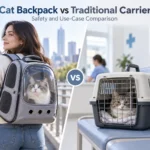
A cat carrier with wheels and a backpack carrier may look like two variations of the same product. From a development standpoint, they are not.
Adding wheels, a trolley handle, and a reinforced base turns a simple carrier into a much more demanding travel product. The overall balance has to feel right, the trolley system needs to stay secure, and vibration should be kept from transferring too heavily into the cabin. Packaging also matters, since the finished structure has to fit efficiently into shipping cartons without driving up freight costs.
A cat carrier backpack is usually simpler mechanically, but it creates a different set of design priorities: shoulder comfort, back support, weight distribution and the overall profile of the bag.
For pet brands planning a new travel range, the choice is less about asking which style is “better” and more about deciding which structure makes sense for the customer, the sales channel and the target price.
1. Cat Carrier With Wheels vs Backpack: The Main Differences
| Product Consideration | Cat Carrier With Wheels | Cat Carrier Backpack |
|---|---|---|
| Main structure | Soft carrier, reinforced base, wheels and trolley | Soft carrier, shoulder straps and back support |
| Hardware | More complex | Relatively simple |
| Product weight | Usually higher | Usually lighter |
| Packaging | Can take more carton space | Easier to fold and pack |
| Main QC focus | Wheels, trolley, balance and base | Straps, stitching and load distribution |
| Typical use | Airports, stations and longer travel | Walking, stairs and urban commuting |
| Development cost | Usually higher | Usually lower |
| Conversion options | Rolling, hand carry, sometimes backpack | Backpack, hand carry, shoulder carry |
This difference sounds straightforward, but it has a big impact once sampling begins.
A brand developing a rolling cat carrier has to make decisions about wheel size, chassis layout, trolley height and base stiffness before the exterior shape is fully finalized. With a backpack, the discussion usually starts with body shape, carrying comfort and ventilation.
That is why the intended use should come first.

2. A Rolling Cat Carrier Is More Than a Soft Bag With Wheels
One of the most common mistakes in early product development is treating the trolley system as an accessory.
It is really part of the carrier’s structure.
When a rolling cat carrier is pulled through an airport, the load moves through the wheels, base plate and trolley connection points. Every turn places lateral force on the lower part of the bag. If the base is too flexible, the carrier can lean. If the wheels sit too close together, it may feel unstable when changing direction.
A better design starts with the chassis.
Depending on the style, the base may use PE board, PP board, EVA reinforcement or a combination of rigid and padded materials. The goal is not to make the bottom as hard as possible. It needs enough support to carry the intended weight while still keeping the product comfortable and reasonably light.
Wheel placement matters just as much. A few millimeters can change the way the bag tracks when it is pulled.
During development, we normally look at the wheel position together with:
- overall carrier width
- expected pet weight
- base stiffness
- trolley mounting points
- interior height
- center of gravity
These details are difficult to judge from a rendering alone. They are much easier to evaluate once a working sample is on the floor.
At Aimazing, we solve these challenges through real sampling and production testing. Our team evaluates different chassis structures by adjusting reinforcement layers, base board thickness and wheel spacing based on the carrier size and target pet weight. We also check trolley connection strength, base deformation and pulling balance during prototype testing before bulk production. These details allow us to turn a concept into a rolling cat carrier that performs reliably in real travel situations.

3. Where a Cat Backpack Makes More Sense
Backpack carriers solve a different problem.
They work well when the owner needs both hands free or when the route includes stairs, crowded streets, subway entrances or uneven ground.
A cat carrier backpack does not need a trolley chassis, so there is more freedom to work with the shape of the bag. The trade-off is that the weight sits on the user rather than on the floor.
That makes strap construction and back-panel support much more important.
For heavier carriers, narrow straps may look clean in a sample photo but become uncomfortable in real use. Strap width, padding density and the point where the strap is sewn into the body all affect performance.
The base also needs attention. If the bottom sags once the cat is inside, the weight shifts away from the back panel and makes the carrier harder to wear.
This is one reason why product development should be based on an actual load range rather than simply choosing a bag size.

4. What About a Cat Backpack With Wheels?
A cat backpack with wheels gives the user both options, which sounds ideal on paper.
In practice, hybrid products take more engineering.
The trolley hardware, wheel housing and backpack straps all compete for space in the same part of the bag. If that area is not planned carefully, the finished carrier can become bulky, heavy or uncomfortable to wear.
A good hybrid design should answer a few basic questions early:
- Where do the backpack straps sit when the carrier is being rolled?
- Can the wheels touch clothing while the bag is being worn?
- Does the trolley hardware reduce usable interior space?
- Is the bag still balanced when carried on the back?
- Can the trolley be removed for cleaning or packing?
These details determine whether a cat backpack with wheels feels like one well-designed product or two ideas forced together.
5. Convertible Pet Carrier Designs Are Useful, but Not Always Necessary
A convertible pet carrier can combine rolling, backpack, shoulder and hand-carry functions.
For some brands, that flexibility is a strong selling point. For others, it adds cost without adding much value.
The key is to match the number of carry modes to the actual travel scenario.
A product aimed at airport and train travel may benefit from a detachable trolley. A lightweight city carrier may be better without it. A premium travel model might justify four carrying options, while an entry-level SKU may work better with two.
More functions also mean more hardware, more sewing operations and more areas that need to be checked during QC.
In other words, versatility has a cost.
The best product is usually not the one with the longest feature list. It is the one where every feature has a clear reason to be there.
As your trusted pet carrier partner, Aimazing helps brands decide which features truly add value based on real production experience. During sampling, our engineers evaluate trolley connections, strap load points, reinforcement areas and hardware durability to ensure each function works properly. By balancing design, materials and manufacturing efficiency, we create convertible pet carriers that are practical, reliable and ready for mass production.

6. Materials Should Match the Product Positioning
There is no single “best” fabric for a wheeled pet carrier.
The right material depends on the retail segment, desired appearance, weight target and expected level of wear.
Polyester and Oxford fabrics are common choices because they are practical, widely available and easy to customize. Nylon can be used where a lighter or more premium hand feel is required. RPET options are also possible for brands building an eco-focused product line.
The outer fabric is only one part of the structure.
A typical carrier may also use:
- PE or PP board for the base
- EVA or foam for padding
- reinforced mesh for ventilation
- aluminum alloy for trolley tubes
- polymer components for handles and wheel housings
The important part is how these materials work together.
For example, a heavy base board may improve stiffness but also increase shipping weight. A very dense mesh may improve scratch resistance but reduce airflow. Larger wheels may roll more smoothly but take up more space in the carton.
Material decisions are rarely isolated.
7. Wheel Choice Changes the Way the Product Feels
Wheels are easy to overlook in a tech pack, but users notice them immediately.
A poor wheel can make an otherwise well-made cat carrier with wheels feel cheap.
Wheel diameter affects how easily the carrier moves over small gaps and uneven flooring. Wheel material influences noise, vibration and wear. The mounting method affects both stability and repairability.
Polyurethane wheels are often considered when a smoother, quieter ride is a priority, but the final choice depends on the overall product concept and cost target.
Detachable wheels are useful in some projects because they make the carrier easier to clean, pack and store.
They also introduce one more mechanical connection that needs to stay secure during use.
That is why quick-release systems should be tested rather than judged by appearance alone.

8. Stability Matters More With Heavier Pets
A rolling cat carrier carrying a heavier cat behaves differently from an empty sample.
The center of gravity moves, the base flexes more and the trolley connection experiences greater pulling force.
This is where prototype testing becomes valuable.
Rather than only checking the finished appearance, the sample should be loaded and moved across the type of surfaces the customer is likely to encounter.
During this stage, it is worth watching for:
- side-to-side movement
- base deformation
- wheel wobble
- unusual noise
- trolley movement
- tipping during turns
A stable carrier is usually the result of several small decisions working together rather than one “anti-tip” component.
9. Ventilation and Escape Resistance Still Come First
Adding wheels does not change the basic requirements of a good cat travel carrier.
The animal still needs airflow, a stable floor and secure openings.
Mesh placement is usually a balance between ventilation, visibility and structure. Large mesh panels create an open feel, but they also reduce the amount of solid fabric available for reinforcement and branding.
Zippers deserve the same attention.
For cat carriers, lockable sliders, zipper clips or dual zipper pulls can help improve closure security, particularly on larger openings.
The base should stay as flat as possible once the pet is inside. If it bends noticeably, the animal shifts toward the lowest point and the whole carrier can feel less stable.
These are basic details, but they often have more impact on user experience than decorative features.

10. Testing a Wheeled Pet Carrier Before Mass Production
A wheeled design introduces moving parts, so the sample should be treated differently from a standard sewn bag.
Depending on the project, testing may include repeated wheel rolling, trolley extension cycles, pull-force checks, load testing and drop or impact evaluation.
The objective is not to create impressive test names.
It is to find weak points while there is still time to change them.
For example, repeated rolling may reveal wheel noise that was not obvious during the first inspection. A loaded pull test may show movement around the trolley mounting points. Turning tests may show that the carrier is too narrow for its intended weight range.
These are much cheaper problems to fix during sampling than after production has started.
11. Packaging Can Change the Commercial Viability of the Product
This is one area that is often discussed too late.
A normal soft pet carrier can usually be folded to some extent. A cat carrier with wheels may have a rigid base, fixed casters and a telescopic frame that prevent the product from compressing.
That difference affects carton size and CBM.
For overseas brands, it can also affect warehousing, container loading and fulfillment cost.
There are several ways to manage this.
A removable trolley can be packed separately. Wheels can sometimes be detached and placed inside the carrier. Soft sidewalls can be designed to collapse while the base remains rigid.
In some cases, a slightly more complicated assembly for the end user may make sense if it significantly reduces shipping volume.
That decision depends on the product and sales channel.
For e-commerce, dimensional weight can be especially important. For retail stores, shelf presentation and ease of setup may matter more.
As your trusted pet carrier partner, Aimazing integrates packaging planning into the product development process. During sampling, our engineers review the carrier structure, trolley system, wheel placement and folding possibilities to optimize carton size and loading efficiency. We also provide customized packing solutions with reinforced protection, space-efficient carton designs and FBA-ready preparation to help brands reduce unnecessary logistics costs while maintaining product presentation and quality.
12. Product Cost Is More Than Fabric Cost
The extra cost of a rolling cat carrier does not come only from the wheels.
There is more hardware, more assembly, more reinforcement and usually more QC work.
A trolley carrier may require:
- additional base panels
- wheel housings
- aluminum tubes
- molded handles
- extra attachment points
- more packing protection
Each part also adds labor.
For this reason, it is useful to define the expected retail position before sampling starts.
An entry-level model may use a simpler wheel system and standard polyester. A mid-range product may justify detachable wheels and better mesh. A premium convertible pet carrier may use upgraded materials, quieter wheels and a removable trolley system.
Designing first and discussing cost later often leads to unnecessary revisions.
13. What Pet Brands Should Confirm Before Sampling
A clear brief saves time.
Before we start a custom cat carrier with wheels project, the most useful information usually includes:
- target pet weight
- approximate product size
- main travel scenario
- preferred carry modes
- target market
- target retail or buying price
- fabric preference
- logo method
- packaging requirements
Even rough answers are useful.
For example, knowing that the product is aimed at airport travel for medium-size cats immediately affects the base, wheels, trolley height and overall dimensions.
Knowing that the brand mainly sells online changes the packaging conversation.
The more clearly the product is positioned, the easier it is to make sensible engineering choices.
14. From Sample to Production
Once the basic direction is clear, development usually moves through several rounds of decision-making.
The first sample is mainly about proportion, structure and function.
At this stage, we check whether the carrier has enough interior space, whether the trolley position feels natural, whether the base stays stable and whether the selected materials suit the intended price point.
A second or pre-production sample can then focus on confirmed materials, branding, hardware and packaging.
Before bulk production, key dimensions and construction details should be fixed so the production team has a clear standard to follow.
During mass production, QC is not limited to the appearance of the finished bag.
For a wheeled carrier, attention also needs to go to:
- wheel installation
- trolley function
- base alignment
- zipper operation
- strap attachment
- dimensions
- packaging
Consistency matters just as much as the quality of the first sample.
15. Customization Options for OEM and ODM Projects
Most cat travel carrier projects can be customized far beyond color and logo.
Depending on the design, brands can change:
- overall dimensions
- outer fabric
- lining
- mesh type
- base structure
- wheel design
- trolley height
- backpack straps
- carrying handles
- zipper configuration
- interior pockets
- labels
- logo application
- retail packaging
For a convertible pet carrier, the carrying system itself can also be developed around the target customer.
This is usually where working directly with an experienced cat bag manufacturer becomes useful. A reference image may show what the customer likes visually, but it does not always reveal what is happening inside the structure.
The sample stage is where those details need to be worked out.

So, Which Structure Should a Brand Choose?
There is no universal answer.
A cat carrier with wheels is a strong option for products built around airports, stations and longer-distance travel. It is especially useful where reducing the amount of weight carried on the shoulder is part of the product concept.
A cat carrier backpack makes more sense for walking, stairs, city transport and situations where hands-free carrying is the priority.
A cat backpack with wheels can cover both scenarios, but it needs more careful development to avoid unnecessary bulk and weight.
For brands, the better question is not:
Which type is easier to travel with?
It is:
Which structure fits the way our customer will actually use the product, and can we manufacture it at the right cost?
That question usually leads to a better product.
Custom Cat Carrier Manufacturing for Pet Brands
Aimazing Bag works with overseas pet brands, importers and distributors on custom pet carrier development, including backpack, rolling and convertible designs.
We can support custom dimensions, fabrics, trolley systems, wheel structures, branding and packaging based on your product brief and target market.
Request Custom Cat Carrier Solution
Frequently Asked Questions
-
Are rolling cat carriers good for travel?
A rolling cat carrier can work very well in airports, stations and other places with smooth flooring because the user does not need to carry the full weight on the shoulder. Wheel quality, chassis balance and base support are especially important for this type of product.
-
Can a cat carrier with wheels be used on a plane?
Potentially, but it depends on the airline and the final dimensions of the carrier. Some designs use removable wheels or detachable trolley frames to reduce the overall size. Airline cabin rules vary, so brands should avoid making broad “airline approved” claims without checking the relevant requirements.
-
What is the difference between a cat backpack with wheels and a standard rolling carrier?
A cat backpack with wheels includes shoulder straps in addition to the trolley and wheel system. A standard rolling carrier may be designed mainly for pulling and hand carrying. The backpack version offers more flexibility but normally requires more structural planning.
-
Are removable wheels worth adding?
They can be. Removable wheels make cleaning and packing easier and may help reduce carton size. The trade-off is that the release mechanism adds another part that needs to be tested for strength and reliability.
-
What materials are commonly used for wheeled pet carriers?
Common materials include polyester, Oxford fabric, nylon and RPET fabrics. The base may use PE or PP board, while the trolley often uses aluminum tubes. Wheel materials vary according to the required noise level, durability and target cost.
-
How can a rolling carrier be made more stable?
Stability depends on several factors working together, including wheel spacing, base stiffness, carrier width, pet weight and center of gravity. These points are best evaluated with a loaded sample rather than from drawings alone.
-
Is a rolling carrier better for a heavy cat?
For heavier cats, wheels can reduce the amount of weight the owner has to carry directly. The product still needs a suitable base, wheel system and trolley structure for the intended load.
-
Can a convertible pet carrier have wheels and backpack straps?
Yes. A convertible pet carrier can combine wheels, backpack straps, hand handles and sometimes a shoulder strap. The challenge is keeping the product comfortable and compact while adding those extra functions.