1. What Airline Approved Dog Carrier Really Means
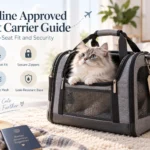
An airline approved dog carrier does not possess an official universal certification from global aviation authorities. Sourcing or manufacturing a reliable airline approved dog carrier requires understanding that regulatory compliance depends entirely on individual airline cabin dimensions. Factory pattern engineers must design compressible soft-walled chassis that adapt to varying under-seat clearances without sacrificing internal pet headroom. Brands must avoid misleading marketing claims because no central regulatory body issues a universal approval seal for soft pet transit gear. Engineering true flexibility into product lines ensures that commercial offerings protect retail brands from costly consumer complaints while optimizing any dog carrier for plane deployment.
-
Primary Question: Does an official global aviation authority issue a universal certification seal for pet carriers?
-
Direct Answer: No central regulatory body issues a universal approval seal, meaning compliance depends entirely on individual airline specifications.
-
Complementary Explanation: Factory engineering must design compressible soft-walled structures that adapt to varying cabin clearances without misleading retail consumers about universal guarantees.

2. Dimensions, Weight Limits, and Fit Rules
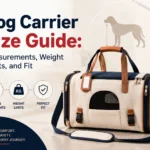
Accurate spatial specifications must calculate interior usable volume rather than relying on deceptive exterior fabric measurements. Sourcing any precision dog carrier for plane transit requires evaluating internal length, width, and height clearances with cushioning installed. Factory pattern engineers account for internal foam padding thickness to ensure that listed pet weight limits match real-world comfort. Overlooking internal volumetric loss leads to cramped enclosures and negative customer reviews. Precise spatial auditing guarantees that retail buyers receive exact performance parameters that rival any premium transit gear, including a verified airline dog carrier.
| Spatial Metric | Deceptive Exterior Dimension | Precision Usable Interior Volume |
| Length Clearance | Measured from outer seam to seam | Reduced by 15mm for internal foam padding |
| Width Capacity | Outer fabric panel perimeter | Constrained by rigid frame insert thickness |
| Height Allowance | Total vertical height from base | Adjusted for safety tether clearance and mesh headroom |

3. Soft-Sided Structure for Travel
Flexible fiberglass stays and semi-rigid EVA base panels allow soft carriers to flex under seat pressure without structural failure. Engineering an optimal dog carrier for airplane deployment requires balancing textile flexibility with dependable load-bearing rigidity. Once compressed by a restricted aircraft seat frame, the internal structure must spring back instantly to preserve breathing space. Factory lamination protocols bond technical face fabrics directly to resilient polymer skeletons to eliminate delamination risks. Superior mechanical engineering separates professional-grade aviation gear from consumer novelty items, matching the structural integrity of any soft sided dog carrier.
-
Primary Question: How do soft carriers achieve under-seat flexibility without compromising structural safety?
-
Direct Answer: Flexible fiberglass stays and semi-rigid EVA base panels allow the frame to compress under seat pressure and spring back instantly.
-
Complementary Explanation: Factory lamination protocols bond technical face fabrics directly to resilient polymer skeletons, ensuring continuous pet headroom during flight compression.

4. Pet Comfort: Posture, Ventilation, and Heat
High-tenacity rubberized mesh window panels must be strategically positioned across multiple sides to ensure continuous cross-ventilation inside aircraft cabins. Designing a top-tier soft sided dog carrier requires optimizing mesh surface area to satisfy airline ventilation mandates without compromising structural tear resistance. Airplane cabins experience fluctuating ambient temperatures and stagnant airflows, making multi-side airflow essential for animal survival. Factory production protocols apply heavy bar-tacking across all mesh perimeters to prevent claw-induced blowouts. Superior ventilation engineering guarantees uncompromised physiological safety during flight for any traveling under seat pet carrier.
| Ventilation Parameter | Engineering Specification | Physiological Protection Objective |
| Mesh Coverage | Greater than 60% total surface perimeter | Ensures continuous cross-airflow and prevents stagnant air |
| Fiber Tenacity | High-tenacity rubberized polyester weave | Resists aggressive claw scratching and tearing |
| Perimeter Stitching | Heavy bar-tacked double-needle seams | Eliminates corner blowout under high-anxiety strain |

5. Leak-Resistant Base and Washable Liner
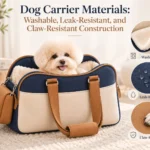
Impermeable bottom pans require high-frequency RF welding or seamless TPU/PEVA lamination to contain accidental fluid spills effectively. Developing a dependable dog flight carrier demands absolute liquid containment to protect aircraft flooring and passenger luggage. Traditional needle-and-thread stitching punches micro-perforations straight through the membrane, turning your foam core into a sponge for liquid spills. High-frequency RF welding completely bypasses that headache by heat-fusing adjacent thermoplastic sheets into a solid, impenetrable, hermetic barrier. Superior seam control establishes an unassailable quality benchmark for aviation soft-goods alongside any airline dog carrier.
-
Primary Question: How do manufacturers eliminate liquid leakage through structural bottom seams?
-
Direct Answer: Manufacturers utilize high-frequency RF welding and seamless TPU/PEVA lamination to create continuous, hermetic barrier joints.
-
Complementary Explanation: Eliminating traditional sewing needle punctures prevents organic fluids from leaking into structural foam cores during accidental spills.

6. Escape-Resistant Closures and Handling
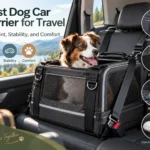
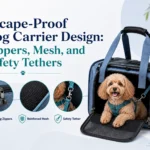
Self-locking zipper sliders and heavy-duty interior safety tethers prevent high-anxiety animals from forcing open containment portals during flight turbulence. Sourcing a premium under seat pet carrier requires integrating locking slider mechanisms that immobilize zipper tracks automatically. Factory production protocols apply heavy bar-tacking across all tether anchor points and zipper terminal stops. Integrated metal swivel clips attach directly to standard pet harnesses to prevent accidental escapes when top loading. Rigorous mechanical security engineering guarantees absolute peace of mind for traveling owners utilizing a verified dog flight carrier.
-
Primary Question: What mechanical features prevent animal escape during flight turbulence or handling?
-
Direct Answer: Self-locking zipper sliders and heavy-duty interior safety tethers prevent high-anxiety animals from forcing open containment portals.
-
Complementary Explanation: Factory bar-tacking secures tether anchor points, while metal swivel clips attach directly to standard harnesses to withstand aggressive pushing forces.

7. Pre-Trip Training and Packing
Acclimatizing pets to their travel enclosure weeks before departure reduces cabin anxiety and ensures calm in-flight behavior. Sourcing an intuitive airline approved dog carrier involves educating retail consumers on positive reinforcement desensitization techniques. Leaving the carrier open in living spaces with familiar bedding inside transforms the enclosure into a secure sanctuary. Pets that view their travel bag as a safe den experience significantly lower physiological stress levels during airport transit. Comprehensive user guides enhance brand loyalty and product satisfaction for every soft sided dog carrier.
-
Primary Question: How can pet owners reduce cabin anxiety through pre-trip carrier familiarization?
-
Direct Answer: Owners can leave the carrier open in living spaces with familiar bedding to transform the enclosure into a secure sanctuary.
-
Complementary Explanation: Positive reinforcement desensitization weeks before departure lowers physiological stress levels during airport transit and in-cabin confinement.

8. Buyer Compliance and Claim Checklist
Regulatory standards governing live animal transport evolve frequently across international airlines, requiring brands to verify policies before finalizing marketing claims. Developing a compliant airline approved dog carrier line demands continuous legal and operational auditing of global aviation updates. Sourcing accurate clearance data protects corporate reputation from false advertising liabilities and costly consumer product recalls. Systematic compliance tracking ensures unassailable ethical authority in competitive export markets. Rigorous oversight safeguards brand equity worldwide when marketing any dog carrier for plane collection.
-
Primary Question: Why must brands verify aviation regulations continuously before publishing marketing claims?
-
Direct Answer: Regulatory standards evolve frequently across international airlines, requiring policy verification to prevent false advertising liabilities.
-
Complementary Explanation: Continuous operational auditing protects corporate reputation from costly product recalls and ensures unassailable authority in export markets.
9. OEM Specification and Quality-Control Plan
Mass production excellence requires establishing an approved golden sample, strict measurement tolerances, and rigorous pre-shipment lot inspections. Manufacturing any custom airline approved dog carrier demands clear quality benchmarks to prevent dimensional variations during sewing assembly. Factory quality control inspectors utilize standardized defect classification charts to intercept non-compliant units before packaging. Verifying stitch density, hardware plating, and zipper smoothness across every batch ensures flawless retail presentation. Systematic quality gatekeeping protects wholesale commercial partnerships across all airline dog carrier production runs.
-
Primary Question: What quality control measures guarantee manufacturing consistency during bulk production?
-
Direct Answer: Measures include establishing approved golden samples, strict measurement tolerances, and rigorous pre-shipment lot inspections.
-
Complementary Explanation: Standardized defect classification charts intercept non-compliant units, verifying stitch density and zipper smoothness across every production batch.
Frequently Asked Questions (FAQs) About Airline Approved Dog Carrier
-
What size dog carrier fits under an airline seat?
Stashing a carrier under an airline seat usually means playing within a tight 17x11x8 to 18x12x10 inch sandbox, though every domestic and international carrier loves to move the goalposts on their exact cabin specs. Scoring a flexible, soft-sided rig with compressible framing is a total game-changer here, letting the whole enclosure squish down safely to clear strict under-seat clearance checks without turning your pet’s ride into a cramped torture chamber.
-
Are airline-approved dog carriers universal?
Airline-approved dog carriers are not universal because no central global aviation authority issues a universal certification seal for pet travel gear. Compliance depends entirely on individual airline aircraft fleet configurations, cabin seating layouts, and regional safety policies. Brands must build multi-policy sizing matrices to satisfy diverse flight operators.
-
Do airlines measure soft pet carriers?
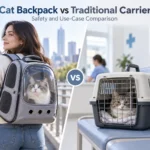
Airlines rarely measure soft pet carriers with a tape measure during boarding, but gate agents will check whether the container fits easily underneath the forward seat. If a bag appears overly rigid or too tall to compress into the designated space, agents may deny boarding. Using flexible fiberglass stays ensures easy cabin insertion.
-
Can a dog stand up in an in-cabin carrier?
A dog cannot stand up fully inside a standard in-cabin pet carrier because commercial airline under-seat height limits restrict vertical clearance to approximately 8 to 10 inches. In-cabin carriers are specifically engineered for resting, turning around, and lying down comfortably rather than upright standing postures.
-
Does a pet carrier need a waterproof bottom?
A pet carrier requires a waterproof bottom pan featuring high-frequency RF welding or TPU/PEVA lamination to contain accidental fluid spills effectively. Waterproof bottom layers protect aircraft cabin flooring and passenger luggage while preventing moisture from rotting internal structural foam cores during transit.
-
How many sides need ventilation?
An in-cabin pet carrier requires ventilation across at least three to four sides, utilizing high-tenacity mesh panels to ensure continuous cross-airflow. Adequate multi-side mesh placement prevents stagnant air accumulation and manages fluctuating cabin temperatures during flight operations.
-
Is a soft-sided carrier better for flying?
A soft-sided carrier is vastly superior for flying because its compressible framing adapts to strict under-seat height restrictions while absorbing mechanical shocks. Rigid plastic crates are generally prohibited inside commercial aircraft passenger cabins due to their inflexible dimensions.