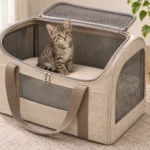
Product photos can make a cat car carrier look sturdy, yet it may behave differently once loaded and placed inside a vehicle. The base may sag, a mesh panel may press against the seat, or the entrance may become difficult to reach. These details affect everyday usability and should be resolved before a design moves into production.
For pet brands, wholesalers and distributors, developing a cat car carrier means considering the animal, the vehicle and the complete product structure together. This guide explains placement, sizing, comfort and verification, then translates those requirements into practical OEM specifications.
1. What Makes a Cat Carrier Suitable for Car Rides?
Short Vet Visits vs Longer Road Trips
The right cat carrier for car rides starts with a defined journey. A short veterinary visit puts particular emphasis on loading, carrying and access at the destination. Longer travel adds cleaning, replacement bedding and luggage compatibility to the development brief.
Extra features should solve a specific problem. A storage pocket is useful only if filling it does not block ventilation or push the sidewall inward. An expandable compartment needs clear instructions about when it may be opened; its presence does not establish suitability for use while driving.
Containment, Comfort and Vehicle Compatibility
Evaluate three questions separately: can the cat remain securely enclosed, can it rest in an appropriate position, and can the product be placed and installed as directed? A positive answer to one does not establish the others.
Closed Carriers vs Open Car Beds
An open booster bed and an enclosed transport bag serve different purposes. Brands should make that distinction clear in product names, photographs and instructions. A tether inside an open bed does not turn it into a closed carrier or establish collision protection.
2. Where Should a Cat Car Carrier Be Placed and Secured?
Start With the Exact Product Instructions
There is no universal installation method for every carrier. Begin with the instructions for the exact model, size and configuration, then check the vehicle handbook. Do not improvise a belt route through a carrying handle or luggage sleeve unless that use is specifically supported.
In its cat transport guidance, AAFP/ISFM distinguishes between crash-tested carriers belted into the back seat and other carriers placed on the rear floor. This distinction matters: a seat belt loop alone does not establish collision protection. Check the evidence and installation directions for the product being considered.
Check the Installed Position
A fit review should examine whether the carrier rests as intended, whether nearby surfaces obstruct mesh, and whether the specified attachment route remains accessible. A product that fits on a bench seat may interact differently with a contoured seat or a restricted rear footwell.
Do not describe a carrier as universally compatible based on a single vehicle demonstration. Record the vehicle and seating position used during development, along with any limitations.

Make Installation Understandable
For OEM projects, installation guidance belongs in the product brief. Diagrams should identify the intended orientation, approved attachment points and prohibited uses. The bag, instruction sheet and online listing should show the same setup.
3. Hard-Sided vs Soft-Sided Carriers: Which Design Trade-Offs Matter?
Compare Complete Structures
Rigid shells, structured textile bags and foldable carriers offer different combinations of storage convenience, access and maintenance. Compare the assembled product rather than assuming one material category answers every safety question.
| Structure | Development advantage | Point to verify |
|---|---|---|
| Hard-sided shell | Defined shape and accessible cleaning surfaces | Door security, assembly connections and handling weight |
| Structured soft carrier | Textile finish with integrated support | Loaded deformation, support retention and connection strength |
| Foldable soft carrier | Compact storage between trips | Correct assembly and repeatable shape after unfolding |
Follow the Load Through the Bag
In a soft carrier, the base, support panels, webbing, handles and seams work together. Reinforcing a handle patch may leave the adjacent fabric as the weakest point. Similarly, a rigid base can still tilt inside an oversized fabric sleeve.
During sample review, use a suitable test load to observe the base, entrance and sidewalls together. Inspect the product while resting and during ordinary lifting. These checks identify usability and durability concerns; they do not simulate a crash.

Balance Folding With Support
A removable support system can simplify storage but introduce assembly errors. Ask whether users can install it backward, leave a panel unsecured or close the bag while a support is out of position. Clear orientation markings and retained components can be considered during development.
4. How to Size a Carrier for Both the Cat and the Vehicle
Measure Usable Interior Space
Published outside dimensions do not describe all the room available to the animal. Padding, sloping walls and support panels reduce usable space. Confirm interior measurements with the normal bedding installed and the bag fully assembled.
Weight capacity is a separate specification. Two cats with the same weight may differ in body length and height. Owners need a size guide that helps them assess whether their cat can stand, turn and lie in a natural position, within the product’s stated limits.
Review Vehicle Fit Separately
Check the outside footprint, door opening and intended installed orientation. Include projecting pockets and handles where they affect fit. Avoid reducing interior space simply to achieve a more compact marketing dimension.
| Fit check | Record during development |
|---|---|
| Interior room | Usable length, width and height with bedding |
| Exterior fit | Assembled dimensions, including relevant projections |
| Entrance access | Clear opening and space needed to operate it |
| Installed clearance | Ventilation, attachment access and nearby obstructions |
| Product limits | Intended pet size and verified load specification |

Set Measurement Tolerances
Soft products can vary with measurement method. Define where dimensions are taken and whether the bag is empty, assembled or loaded. Agreed tolerances help prevent a production batch from drifting away from the approved sample.
5. Comfort Design: Ventilation, Privacy and a Stable Resting Surface
Assess Airflow in the Installed Configuration
Mesh coverage should be assessed in use, not only in a studio photograph. A large window offers less benefit when it sits against upholstery or beneath a privacy flap. Review the assembled bag with normal accessories and the specified installation arrangement.
For a cat carrier for car rides, ventilation and structural support need coordinated placement. Adding mesh removes solid panel area, which may change how a sidewall holds its shape. Evaluate that trade-off through sampling rather than prescribing an unsupported universal mesh percentage.
Give Privacy Panels Clear Limits
Some cats prefer visual shelter. A partial cover can provide it, but its position should preserve the intended ventilation openings. Fasteners should hold the cover where directed and avoid loose loops inside the animal compartment.

Keep the Resting Surface Stable
Padding should provide comfort without bunching or sliding. Check the pad’s fit, attachment and edges, especially after washing. Excessive thickness can reduce headroom without improving support.
VCA’s car travel guidance recommends gradual familiarization with the carrier and vehicle. Accessible openings and familiar bedding can support that routine, but a product design should not promise to eliminate anxiety or motion sickness.
6. Escape-Resistant Openings, Zippers and Handling Details
Choose Entrances for the Actual Use
A top opening can help with access, while a side entrance may support voluntary entry at home. More entrances also introduce more closures and seams to inspect. Choose openings for a reason rather than treating their number as a quality score.
Check whether support panels obstruct the opening and whether a loaded bag distorts the zipper track. Review access after installation as well as during hand carrying.
Inspect the Complete Closure System
Specify the zipper, slider, puller arrangement and any retaining clip together. Inspect end stops, corners, mesh attachment and gaps around overlapping panels. A lockable puller does not compensate for weak mesh or a poorly secured zipper end.
Use the term “escape-resistant” only with an appropriate basis. Avoid an absolute “escape-proof” claim that suggests every animal and use condition has been covered.
Separate Handling From Vehicle Restraint
Handles and shoulder straps need their own durability checks. Their purpose must also be clear: an ordinary carrying strap is not automatically a vehicle restraint point.
If an internal tether is included, define its intended use and limitations. It should not be promoted as crash protection, and its configuration requires review for entanglement and misuse risks. Keep the main enclosure reliably closed during transport.
7. Cleaning and Long-Trip Practicality: Liners, Spills and Storage
Design for Removal and Replacement
A removable pad is useful when it can be taken out without dismantling the support structure. Consider a washable cover, a replaceable absorbent layer and access to the surfaces beneath them.
When specifying a cat travel carrier for car journeys, decide which components users can wash, which require wiping and which must stay dry. Separate instructions prevent owners from washing an entire assembly when only the pad cover is suitable.

Distinguish Water Resistance From Leak Resistance
A coated fabric may resist water while stitched seams still allow liquid through. If the product makes a leak-resistance claim, define the finished-product test conditions and acceptance criteria. Do not infer whole-bag performance from a fabric sample.
Inspect piping, corners and the underside of the base sleeve for cleaning access. A smooth lining provides limited benefit if moisture can remain trapped around an inaccessible insert.
Keep Storage Outside the Resting Area
Pockets should accommodate the intended items without pressing into the cat’s space. Check them filled during sample approval. Avoid placing bulky accessories where they obstruct a mesh panel, closure or installation path.
8. What Testing Evidence Should Buyers Request?
Separate Durability From Collision Performance
Every claim should connect to a relevant method and result. Routine inspection can assess assembly and visible defects, while targeted testing evaluates specific performance questions.
| Check or evidence | What it can help establish | What it does not establish by itself |
|---|---|---|
| Handle and seam loading | Performance under defined loads and durations | Crash protection |
| Zipper cycling | Repeated operation under stated conditions | Resistance to every escape attempt |
| Mesh and seam testing | Performance under defined mechanical methods | Indestructibility |
| Cleaning trials | Changes after the stated cleaning procedure | Whole-product washability unless evaluated |
| Dynamic crash report | Results for the tested setup | Performance of every size or installation |
Use calibrated equipment, appropriate fixtures and agreed methods. Set thresholds according to the intended product and market; a generic factory test number is not automatically suitable for every carrier.
Match Reports to the Exact Configuration
Request the product identifier, size, test load, installation method and report date. Compare the tested construction with the current bill of materials. A similar appearance or shared brand name is insufficient.
The Center for Pet Safety certification program provides an independent reference for certified products. Its stated commitments include meeting independently developed standards, monitoring quality and truthful marketing. Check the relevant listing and scope rather than relying only on a promotional badge.
Review Changes Before Reusing Claims
A different buckle, support panel, webbing route or seam construction may affect performance. Establish when laboratory or certification-provider review is needed. Routine factory QC should preserve the approved specification, while collision claims require their own supporting evidence.
9. OEM Development Details: From Product Brief to Approved Sample
Define the Product Before Choosing the Finish
An effective brief identifies the target animal, journey, product format and intended claims before colors and logos are finalized. For a cat travel carrier for car use, the installation concept and verification plan should be discussed early.
Aimazing supports brands with material selection, structure development, sampling and production through its custom pet travel bag manufacturing services. The development task is to turn each requirement into a construction detail that can be reviewed and reproduced.
Use a Written Sample Approval Sheet
| Specification | What to confirm |
|---|---|
| Dimensions | Interior and exterior measurements, method and tolerances |
| Support structure | Base material, panel placement, retention and assembly |
| Materials | Fabric, coating, mesh, lining and approved references |
| Closures | Zipper specification, openings, end stops and retaining parts |
| Hardware and webbing | Component identifiers, routing and connection construction |
| Bedding | Thickness, fit, removal and cleaning instructions |
| Performance | Test methods, loads, cycles and acceptance criteria |
| User information | Installation diagrams, limits, labels and care instructions |
| Packaging | Packed dimensions and checks after unpacking |
For example, a brand may request a bag that folds flat for retail distribution. The prototype review should then include unpacking, support installation and loaded-shape checks. This is a development scenario, not evidence that the design has passed vehicle collision testing.

Freeze the Approved Construction
Keep a signed sample, agreed measurements, bill of materials and revision record. Specify which substitutions require approval. Logo placement should also avoid interfering with mesh, structural stitching or closure operation.
Aimazing offers sampling in 3–5 days, with timing confirmed against the design and material requirements. Specialized validation should be scheduled separately. The OEM/ODM customization process helps buyers organize development from the initial brief to production approval.
10. Cat Car Carrier FAQs
Where Should a Carrier Go in a Car?
Follow the exact product’s installation instructions and check the vehicle handbook. Feline transport guidance distinguishes rear-seat installation of crash-tested products from rear-floor placement of other carriers. Confirm the applicable setup rather than assuming any bag can be belted onto a seat.
Can Every Carrier Be Secured With a Seat Belt?
No. A handle, luggage sleeve or fabric loop does not establish an approved restraint method. The relevant product instructions and evidence should identify the supported belt route and configuration. Do not create an attachment method based only on where a belt appears to fit.
Are Soft-Sided Carriers Suitable for Car Travel?
Assess the specific model, its intended use, structure and supporting evidence. “Soft-sided” describes a broad product category. It does not establish either collision performance or incompatibility with vehicle travel. Likewise, a hard shell alone is not proof of crash protection.
Does a Seat Belt Loop Mean a Carrier Is Crash-Tested?
No. A loop is a construction feature. Crash testing requires evidence for a defined product and setup; certification involves the applicable program’s requirements. Routine load tests and reinforced stitching do not replace either.
What Should a Brand Send an OEM Manufacturer?
Provide the target cat size, intended journeys, reference drawings, interior-space requirements and preferred materials. Include installation expectations, cleaning needs, packaging and any intended performance claims. These details allow the factory to identify design questions and validation needs before the sample is approved.
Developing a cat car carrier starts with clear requirements and ends with a repeatable specification. Share your target dimensions, use scenario and reference design with Aimazing’s development team to discuss structure, material options and a sampling plan for your brand.