Introduction
Pulling off custom sleeves really comes down to solid patterns, good thermal materials, and crisp printing. Whether you’re messing around with a first sample or getting ready to scale up a retail collection, figuring out how to make a beer koozie is where killer merch starts. As a direct OEM factory, we take your designs and handle the heavy lifting to turn them into bulk, high-quality production.
1. Materials and Tools You Will Need for Koozie Production
1.1 Neoprene and Foam Core Selection
Neoprene is a premier synthetic rubber polymer engineered for superior stretch and exceptional thermal insulation. Wetsuit-grade material provides tight structural memory that conforms snugly to diverse beverage containers. Sourcing high-grade neoprene requires verifying thickness tolerances ranging between 2mm and 4mm to balance flexibility with insulation performance. High-density EPE and open-cell foam deliver lightweight structural integrity for high-volume promotional merchandise. Open-cell structures trap air pockets effectively to slow down ambient heat transfer without adding excess weight. Evaluating foam density parameters ensures that finished sleeves maintain rigidity during active outdoor usage while remaining economical for bulk distribution.

1.2 Fabric Selection and Sizing Standards
Polyester fabric and elastic binding are essential components when executing a professional how to make a can koozie workflow. Durable outer textiles protect internal thermal layers from surface friction and environmental degradation. Selecting high-grade edge binding prevents fraying and guarantees a clean aesthetic finish across all manufactured units.
| Component Material | Primary Function | Ideal Application |
| Polyester Fabric | Outer graphic display and abrasion protection | Custom printed retail merchandise |
| Elastic Binding | Edge finishing and structural reinforcement | Preventing fraying on high-wear rims |
| Wetsuit Neoprene | Core thermal insulation and elasticity | Premium outdoor and beverage lines |

2. Standard Beer Can Koozie Dimensions and Pattern Design
2.1 Core Pattern Engineering Principles
Engineering an optimal beer koozie pattern requires precise calculations of container height and circumference tolerances. Standard 12-ounce aluminum cans measure approximately 2.6 inches in diameter and 4.8 inches in height. Pattern designers must incorporate negative ease allowances to ensure the sleeve stretches tightly against the container surface.
2.2 Sizing Variations and Container Scaling
Designing versatile production lines requires adapting master templates to fit multiple beverage container shapes safely.
| Scale Type | Dimension Specification | Functional Fit Purpose |
| Slim Can Scaling | Approx. 2.25 inches base diameter | Fits tall seltzer containers securely |
| Standard 12oz Calibration | Standard cylinder template design | Ensures tight friction fit for traditional cans |
| Bottle Accommodations | Variable neck and base clearances | Handles irregular glass geometries efficiently |

3. Step-by-Step Guide: How to Make a Beer Koozie
3.1 Stitching and Thermal Bonding Techniques
Mastering how to sew a beer koozie means using the right stitch count and heavy synthetic thread. Industrial shops use zigzag or flatlock stitches so the wetsuit material keeps its stretch. Alternatively, thermal bonding skips traditional thread entirely for seamless, watertight sides.
3.2 Industrial Workflow Execution
Executing industrial production requires a systematic sequence of digital drafting, precision laser cutting, and graphic application. Raw panels are first printed with custom brand logos before undergoing automated side-seam stitching. Final edge binding application completes the structural assembly, followed by strict quality control inspections.
-
Digital Drafting Phase: Precision computer-aided layout planning ensuring pattern dimensional accuracy.
-
Laser Cutting Stage: Automated panel separation preventing frayed edges and material distortion.
-
Assembly and Finishing: Automated stitching and binding application guaranteeing absolute structural uniformity.

4. Printing and Customization Methods for Koozies
4.1 Printing Technology Comparison
Getting custom koozie printing right usually means picking between screen printing, dye-sublimation, and heat transfer depending on your fabric. Screen printing works great for laying down bold, solid logos on textured neoprene or foam. Dye-sublimation, on the other hand, actually sinks right into polyester outer layers so you get full-color graphics that won’t crack or fade over time.
| Printing Method | Core Technical Feature | Branding Performance |
| Screen Printing Method | Direct ink application on textured substrates | High-contrast, vibrant, and opaque logos |
| Dye-Sublimation Technique | Permanent fabric fiber penetration | Crack-resistant, continuous full-color graphics |
| Heat Transfer Application | Pressure and thermal activation application | Cleaning pre-printed digital logos onto fabric |
4.2 Advanced Decoration and Embroidery
If you’re trying to make your merch feel less like cheap promo gear and more like actual retail stuff, precision embroidery is definitely the move. Slapping a multi-color embroidered logo onto canvas or neoprene gives it that textured, premium feel that instantly elevates the whole piece. Industrial embroidery heads maintain exact stitch density standards to prevent fabric puckering during high-speed execution.
Whatever custom branding method you choose, we’ll tailor the right solution to your needs and help your brand stand out.

5. Foam vs. Neoprene: Material Comparison in Koozie Manufacturing
5.1 Material Performance Comparison Matrix
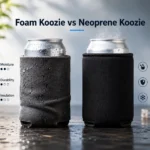
Balancing cost-to-performance ratios determines whether to select classic foam or advanced polymer composites for large-scale campaigns. Classic open-cell foam offers unbeatable unit cost economics for massive promotional event giveaways. Advanced neoprene composites are reserved for premium retail collections where superior cold retention justifies higher material expenses.
-
Thermal Efficiency Metrics: Classic foam provides a moderate insulation baseline while neoprene ensures superior cold retention.
-
Water Resistance Profiles: Open-cell foam remains porous and absorbs moisture, whereas neoprene features a 100% waterproof polymer structure.
-
Cost Profile Economics: Foam is highly economical for bulk mass giveaways, contrasted by premium pricing for retail-grade neoprene lines.
For a detailed comparison, you may read about this Foam vs Neoprene Koozie guide.
5.2 Manufacturing and Lamination Standards
When it comes to Neoprene koozie manufacturing, you have to be super strict about polymer density and waterproof lamination. Real wetsuit material has that buttery-soft feel and heavy-duty water resistance that high-end brands love. On top of that, proper vulcanization fuses the inner rubber core straight to the outer fabric so it never peels apart, even after years of use.

6. From Prototype to Bulk: The Industrial Koozie Manufacturing Process
6.1 Industrial Production Advantages
If you look closely at the koozie manufacturing process, you’ll notice that automated die-cutting and high-frequency welding have pretty much replaced slow hand-stitching to speed things up. Industrial cutting tables also handle material nesting automatically, which cuts down on wasted fabric during massive production runs. Heat-sealing technology melts polymer edges together instantly, achieving superior waterproof seals and massive daily capacities.
-
Automated Die-Cutting Optimization: Optimizes material nesting tables to minimize fabric waste efficiently across runs.
-
High-Frequency Welding Power: Instantaneous polymer edge melting achieving superior waterproof seals and massive output.
-
Rapid OEM Turnaround Delivery: Flexible factory scheduling integration allowing production and shipment completion within 5 to 7 days.
6.2 Supply Chain Execution and Prototyping
Understanding how are koozies made on an industrial scale helps clients appreciate the value of streamlined prototyping workflows. Brand partners validate pre-production samples before committing to full-scale commercial manufacturing. Rigorous multi-point quality control inspections protect brand equity across every outgoing shipment.
-
Process Decoding Phase: Replacing manual stitching with automation to achieve high-speed volume output.
-
Sample Validation Protocol: Pre-production prototyping verification mitigating bulk manufacturing risks.
-
Quality Control Inspection: Rigorous multi-point inspections protecting brand equity across shipments.

7. Frequently Asked Questions (FAQ)
7.1 Minimum Order Quantities and Customization
Minimum order quantities vary depending on material selection and printing complexity, typically starting at 300 – 500 units for custom wholesale runs. Flexible OEM manufacturing setups accommodate trial batches for emerging brands launching new promotional campaigns. Lower MOQs apply when utilizing standard in-stock fabric colors and simple single-color screen printing.
7.2 Waterproof Sealing and Structural Integrity
Factories apply specialized waterproof seam seal tape or utilize high-frequency ultrasonic welding to eliminate needle-hole leakage on technical beverage holders. Stitched seams receive reinforcement backing to withstand constant mechanical stress during daily outdoor usage. Welded polymer panels achieve absolute 100% waterproof integrity without requiring traditional thread lines.