1. Introduction
In the global bag manufacturing industry, “experience” is often used as a shield for “obsolescence.” Many factories boast 20 years of history, but they are still using 1990s workflows. Twenty years in the trenches, moving from simple totes to complex signal-blocking tech, has taught me that ‘cheap’ is often the most expensive word in manufacturing. When a vendor joins the race to the bottom on price, they inevitably cut corners on technical integrity. The money you save on the initial invoice is almost always lost ten-fold when the product fails in the hands of your customer.
By 2026, market leadership has moved far beyond surface-level aesthetics like the ‘color of the year.’ We are seeing a fundamental shift where material science, digital agility, and ethical transparency have become the three non-negotiable pillars of a brand’s survival.
Here is the definitive 10-point framework for evaluating if a manufacturer is a strategic asset or a liability.
2. R&D Proactivity: The “Early Warning System”
A factory’s R&D department should act as your scout. Traditional manufacturers wait for a Tech Pack; trend-aligned partners present concepts before you even know you need them.
- Quarterly Trend Forecasting: Top-tier factories maintain internal design teams that synthesize data from WGSN, Premiere Vision, and street-wear movements to create “white-label” samples.
- The “Sample Library” Freshness Test: When auditing a factory, look at the dust. If the showroom is filled with designs from five years ago, the factory has lost its pulse. A leading partner refreshes their library every 180 days.
- Innovation Logic Comparison:
| Metric | Reactive Factory (Follower) | Proactive Factory (Leader) |
| Initial Inquiry | “Send us your sample/drawing.” | “Here are 5 new silhouettes for Q3.” |
| Material Sourcing | Uses stock market fabrics. | Develops exclusive, sustainable textiles. |
| Sample Lead Time | 14–21 days (Paper patterns). | 3–7 days (3D/Digital prototypes). |
| Hardware | Basic zinc alloy/plastic. | Magnetic Fidlock, Aero-grade Aluminum. |
3. Vertical Specialization: The Death of the Generalist
The “Jack of all trades” model is failing. High-performance trends—like Gorpcore, Technical Medical Gear, and Odor-Proof Storage—demand hyper-functional precision that a generalist factory cannot replicate.
- Understanding the Physics: A specialist in functional bags understands the science, not just the sewing.
- Smell-Proof Technology: Understanding Van der Waals forces and carbon density for physical adsorption.
- Faraday Technology: Mastering signal attenuation (dB) through specialized conductive seams.
- Medical Gear: Knowledge of antimicrobial coatings and ISO-standard durability.
- Dedicated Machinery Investment:
- Technical Benchmarking: True precision requires heavy-duty investment. Our facility integrates High-Frequency welding for seamless durability, Vacuum testing for functional reliability, and Signal-spectrum analyzers to validate Faraday spectrums. We don’t just make bags; we engineer performance.
3. Agile Production: The “Small Batch, Fast Chase” Model
Social commerce has compressed trend cycles. A viral post on TikTok can create demand that lasts only four weeks. Your factory must be built for speed.
- Flexible MOQ (Minimum Order Quantity): The old “3,000 unit minimum” is a relic of the past. Modern factories offer lower MOQs for initial market testing, allowing brands to gauge consumer sentiment without heavy inventory risk.
- Rapid Restock Capabilities: Evaluate the factory’s “chase” capacity—the ability to reproduce a winning SKU in 30 days or less.
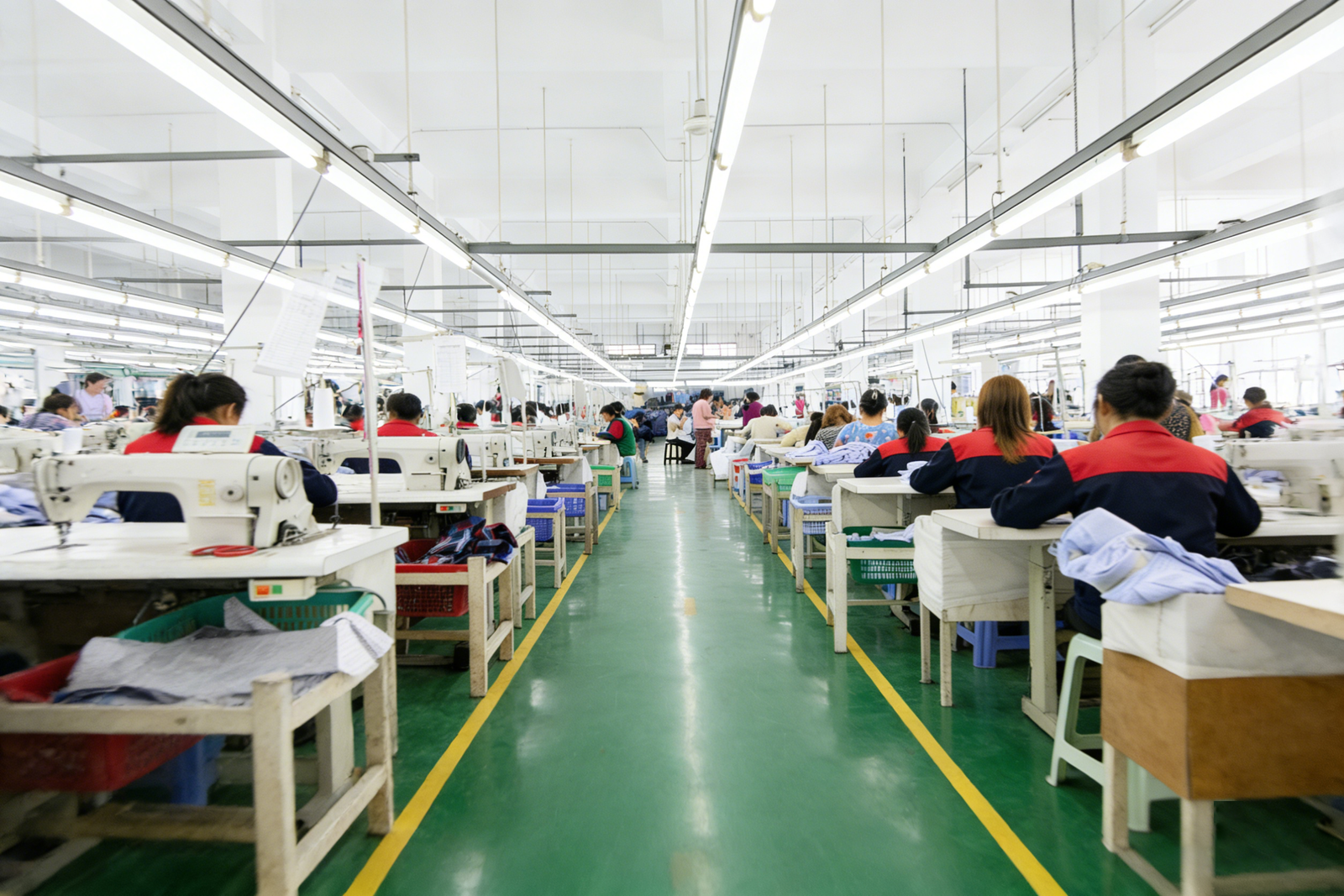
- Modular Assembly Lines: Lean manufacturing isn’t just about waste reduction; it’s about operational agility. Our lines are engineered to transition between complex technical gear and everyday carry items with near-zero downtime. For our clients, this means a faster response to viral market trends without the traditional manufacturing delays.
4. Digital Integration: The 3D Design Revolution
The traditional sampling process is the greatest bottleneck in the supply chain. If your factory hasn’t embraced a ‘Digital-First’ workflow, they are essentially a bottleneck to your growth. Relying on physical prototypes alone means wasting weeks on international couriers for minor adjustments that should take minutes in a virtual 3D environment.
- Virtual Prototyping (CLO 3D / Browzwear):Instant Iteration: Changing a zipper color, moving a pocket, or adjusting a gusset width takes seconds digitally.
- Stress & Tension Maps: 3D software can simulate how a bag drapes when full or where the fabric will likely tear under load.
- E-commerce Readiness: High-fidelity 3D renders can be used for pre-sales or “coming soon” marketing campaigns before the first physical unit is even finished.
5. Advanced Construction: Engineering vs. Traditional Stitching
As tech-wear becomes mainstream, bag construction is moving toward engineering. You must audit the factory’s technical capabilities.
- The Technical Equipment Checklist: Ultrasonic Welding: Essential for 100% waterproof, stitchless aesthetics.
- Laser Cutting: Guarantees 0.1mm precision and cauterizes the edges of synthetic fabrics to prevent fraying.
- Automated Stitching: By integrating Lean methodologies, we’ve built a modular workflow that allows for a frictionless pivot between styles. Whether we are shifting from a high-spec technical backpack to a minimalist crossbody, our lines are engineered to eliminate re-tooling bottlenecks and costly downtime. This is how we help brands respond to viral trends in real-time.
Heat Sealing & Bonding: For a sleek, “no-seam” look found in premium minimalist brands.
6. Supply Chain Transparency & ESG Compliance
Market trends are no longer just about color; they are about ethics. Consumers demand to know the origin of every component.
6.1 Certification Audit
- Social Responsiblity: Validating BSCI or SEDEX audits to ensure fair wages and safe working conditions.
- Sustainability: Assessing GRS (Global Recycled Standard) certificates for recycled nylons and polyesters.
- Chemical Safety: Ensuring alignment with REACH and RoHS to prevent toxic materials from entering the global market.
- Carbon Footprint Monitoring: High-performing factories now track water usage, implement solar power on-site, and utilize energy-efficient machinery to lower the “per-piece” carbon impact.
7. Functional Performance Testing: The Internal Lab
In a market where “quality” is a baseline, specialized testing protocols are what differentiate a partner from a vendor. Your factory must back up its claims with data.
Standardized Testing Metrics:
| Test Name | Metric Measured | Target for Premium Gear |
| Tensile Strength | Force required to tear seams. | > 400N for load-bearing straps. |
| Salt Spray Test | Hardware corrosion resistance. | 48-72 hours without oxidation. |
| Color Fastness | Resistance to UV and rubbing. | Grade 4.0 or higher. |
| Load Cycle Test | Durability of handles over time. | 5,000+ cycles at 15kg load. |
| Signal Block Test | Faraday cage effectiveness. | > 80dB attenuation (800MHz-5GHz). |
8. Strategic Location: The “Cluster Advantage” of Shiling
A factory is only as fast as its local ecosystem. Our location in Huadu Shiling (Guangzhou)—the Leather Capital of China—provides an insurmountable edge.
- Zero-Day Sourcing: Trends often emerge at the material level first. Being “on the ground” allows us to spot new textures, finishes, or hardware weeks before they hit international trade shows.
- Logistical Efficiency: Reducing the distance between the material supplier and the factory floor cuts down on internal lead times and shipping costs.
- Niche Supplier Access: Whether it’s specialized YKK AquaGuard zippers or custom-molded magnetic buckles, being in a cluster means we have immediate access to the best sub-suppliers in the world.
9. Portfolio Audit: The “Company They Keep”
The most reliable indicator of a factory’s trend alignment is their current client base. A factory producing for innovative, global “trend-setter” brands has already been vetted for you.
- Complexity Benchmarking: Look for products with high technical complexity—multi-compartment technical backpacks, hybrid material construction (leather + TPU), or integrated electronics.
- International Standards Awareness: Factories accustomed to exporting to Australia, New Zealand, Europe, and North America naturally align with those regions’ specific lifestyle needs and aesthetic preferences.
- Confidentiality Protocols: A professional factory demonstrates how they protect Intellectual Property (IP) while showcasing their manufacturing prowess.
10. Digital Management Systems: Radical Transparency
The relationship shouldn’t end when the deposit is paid. You need real-time visibility into your production.
ERP System Integration: Modern factories utilize Enterprise Resource Planning systems to track raw materials, labor costs, and production timelines.
Digital QC Logs: Instead of a paper report at the end, you should receive digital QC logs that allow you to see defect rates and resolutions in real-time.
Cloud-Based Tech Packs: Centralized digital files ensure that every department—from cutting to final packing—is working off the most recent version of a design, eliminating the risk of “old version” errors.
11. The Final Verdict: Choosing a Strategic Partner
At the end of the day, aligning with a factory that actually ‘gets’ market trends means looking far beyond the bottom line of a quotation. You need a partner who functions as a strategic consultant—a team that proactively helps you steer through the complexities of material innovation and technical hurdles, while ensuring your brand stays on the right side of global ethical requirements.
At Aimazing Bag, we don’t just manufacture; we engineer. We understand that your brand’s reputation is in our hands with every stitch.
Final Evaluation Checklist for Brands:
- Does the factory offer design or material suggestions proactively?
- Are they invested in 3D virtual sampling and automated machinery?
- Do they have a proven track record with other trend-leading brands?
- Is their communication fast, transparent, and digitally integrated?
If your current supply chain is holding your brand back, or if you’re curious about the technical shifts we’re driving at our Guangzhou facility—from Faraday signal-blocking to advanced carbon adsorption—let’s have a real conversation. I don’t just want to be your manufacturer; I want to be the reason your next collection leads the market instead of chasing it.