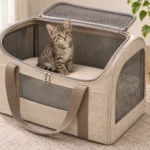
Choosing a cat carrier with litter box starts with one question: where will the cat use the tray? Some designs build a pan into the base, others hold a removable tray inside, and some include a separate folding box for use during stops or after arrival. For pet brands developing a long-distance travel carrier, that choice determines how much room the cat has, how the owner cleans the carrier, and what the factory needs to verify before production.
1. What Is a Cat Carrier With Litter Box, and When Is It Useful?
The phrase can describe either a carrier designed to hold a litter tray or a travel kit that includes one. The distinction matters when a customer expects the cat to have access to litter inside the carrier. Product photos and packaging should show where the tray goes, whether it is included, and which configurations are intended for transport, stops, or use after arrival.
An internal tray is worth considering when the carrier has enough usable room for the cat to stand, turn, and lie naturally with the tray fitted. A separate box preserves the full carrier floor and can be set up in a secure, enclosed place during an appropriate stop or after arrival. VCA’s road-trip guidance discusses both options, including placing a small litter pan inside a sufficiently large travel kennel.
2. Three Litter Box Layouts for Long-Distance Travel

| Layout | How the owner uses it | What the brand should verify |
|---|---|---|
| Integrated slide-out pan | Exposes the pan built into the base and withdraws it for cleaning. | Base depth, full pull-out clearance, and the opening exposed when the pan is removed. |
| Removable tray fitted inside | Places the tray in a designated position and removes it to free up the floor. | Tray retention, gaps around the tray, and floor flatness after removal. |
| Separate folding litter box | Packs the box with the carrier and sets it up separately. | Folded dimensions, storage after use, and availability of replacement boxes. |
Integrated Slide-Out Pan
A built-in pan gives the owner a designated place to reach for cleaning. It also adds depth to the base and needs a clear path for removal. On the prototype, check whether a user can grip the pan, pull it out, and keep it level without lifting or rotating the carrier. A pan that slides freely on a workbench may be harder to withdraw beside a seat or packed luggage.
Removable Tray in a Structured Soft-Sided Carrier
A cat carrier with litter tray can use a fitted recess or a restraint to keep the insert in position. Check the fit with the carrier lifted under its intended load, when the base and sidewalls can flex. After removing the tray, verify that the liner lies flat and covers any exposed fasteners or edges.
Separate Folding Litter Box
A folding box keeps the carrier floor available in transit and gives the brand flexibility to sell the box as part of a kit or as a replacement. Decide where it will be stored both before and after use. If the kit includes a storage pouch for the used box, check that the pouch fits the folded box without sharing space with clean bedding.
3. How to Size a Cat Carrier for Long Distance Travel With the Tray Installed
Measure the Floor Space the Cat Can Actually Use
Fit the production-intent floorboard, liner, resting pad, and tray before measuring. On a top-view drawing, mark the tray footprint, any frame or wall intrusions, and the largest continuous area available for resting and turning. Then measure the usable interior height and the clear dimensions of the entry.

Avoid estimating usable space by subtracting the tray area from the total floor area. Two narrow strips around a pan may add up to a generous number on paper while leaving very little room for the cat to lie down. If the tray divides the only usable resting area, revise the floor layout or make the tray a separate accessory.
Check Transport, Parked Use, and Storage Separately
Record the dimensions with the tray installed, with it removed, and with any parked-use expansion deployed. Check whether the tray or its divider covers part of a ventilation panel. Then verify the clearance needed to open the access panel and remove the tray in the intended setting. For the broader questions of vehicle fit and placement, see Cat Car Carrier Design.
4. How to Design a Cat Carrier With Litter Tray for Easier Cleaning
Control Tray Movement and Litter Scatter
A taller rim can help contain loose litter, but it also increases the step into the tray and reduces the available height above it. Review both dimensions against the intended cat size range. Pay particular attention to the gap between the tray and the liner. If granules migrate under the support board or into a zipper track, a quick wipe of the visible surface will leave part of the carrier dirty.
Check the Opening Throughout Tray Removal
A dedicated access panel can simplify cleaning if the main door stays closed and the enclosure remains intact while the tray is withdrawn. Inspect the prototype with the tray halfway out and fully removed. If removing the tray creates an opening into the enclosure, specify a secure, enclosed setting for that step and show the sequence in the instructions.

Separate the Washable Liner From the Support Board
Make the washable liner removable independently of the structural base so each part can be cleaned or dried as intended. Inspect corners, seams, and zipper ends for possible leakage paths. Test liquid leakage and litter scatter separately. Liquid can reach a stitched seam, while dry granules can lodge in a gap above it.
5. What Changes When the Carrier Is Used for Moving?
A cat carrier for moving has to work through three stages. During loading, the closures and handles need to be easy to check while people and boxes are moving through doorways. During an appropriate stop, the owner needs to reach the tray or supplies without unpacking the vehicle. After arrival, the carrier and a litter box can be set up in a quiet, enclosed room with familiar bedding and supplies.

For a cat carrier for long distance travel, an illustrated instruction card can show which panels stay closed in transit, which accessories are set up during a stop, and how to remove and reinstall the tray. A replacement liner, a folding pan, and a pouch for used items can be specified as kit components or sold separately. Give each replaceable part its own dimensions and compatibility information so a customer can reorder it later.
6. What Real Products Reveal About Built-In and Bundled Trays
MidWest Skudo Uses the Base to House the Pan
PetSmart lists the MidWest Skudo with a built-in litter pan beneath a sliding cover. The pan can be removed for cleaning, and the base includes storage for a scoop. For a product development team, this layout raises two practical questions. How much height does the pan assembly add to the base? How far must the pan extend beyond the carrier before it can be lifted clear? Both dimensions belong on the drawing.
Petsfit Treats the Folding Tray as a Kit Component
Kohl’s lists a Petsfit travel set with foldable carriers and a separate folding litter box. This configuration lets the carrier and tray be specified independently. For a retailer or distributor sourcing a similar set, the order documents should identify the carrier configuration, tray dimensions, component quantities, and how the parts are packed together.
7. OEM Quality Checks for a Cat Carrier With Litter Box
Turn Product Claims Into Sample Checks
Use an assembled sample with the specified tray, liner, floorboard, and hardware. Agree on the load, handling sequence, number of cycles, and pass criteria before testing. The sample checks below can then be carried into the production specification.
| Check | Sample procedure | What to record |
|---|---|---|
| Tray retention | Lift and tilt the sample with representative test loads in the agreed positions. | Tray displacement, release from the restraint, and floorboard deformation. |
| Litter scatter | Use an agreed granule type and fill level, then repeat the specified handling sequence. | Whether litter reaches the resting area, zipper track, space beneath the board, or exterior. |
| Liner leakage | Apply an agreed volume of test liquid for a defined period, then inspect beneath the liner and around the seams. | Where liquid reaches the support board or exterior and how far it spreads. |
| Removal and refitting | Remove, clean, and reinstall the tray for the agreed number of cycles. | Jamming, loose retention, access panel alignment, and any gaps after refitting. |
| Folding and reopening | Fold and pack the carrier as specified, then reopen and assemble it. | Base flatness, frame recovery, and whether the tray still seats correctly. |
Routine handling and cleanout checks support claims about those specific uses. Any claim about vehicle collision protection requires separate evidence for the intended configuration.

Carry the Approved Details Into Bulk Inspection
Keep an approved reference sample and a drawing that records the tray dimensions, floorboard thickness, restraint position, and fit tolerances. During bulk inspection, check that the tray seats and releases as expected, the liner lies flat, and the correct accessories and instruction card are in the carton. A sample can match the published outer dimensions and still fail its intended use if a seam narrows the tray pocket or the carton contains the wrong insert.
8. How Pet Brands Can Brief an OEM Bag Manufacturer
Define the Cat Size Range, Travel Mode, and Tray Format
For a cat carrier for moving, specify whether the tray must fit inside the carrier or travel separately for use during stops and after arrival. Include the intended cat size range, the available vehicle or storage space, the dimensions in each configuration, the accessory list, the packaging format, the order quantity, and the destination market. A top-view sketch showing the tray, resting area, and access openings gives the sampling team a starting point.
Agree on the Sewn Components, Sourced Parts, and Tooling
With over 2 decades of custom pet carrier manufacturing experience, Aimazing Bag can develop the soft-sided carrier around the fabric body, structural base, removable liner, and closure layout. If the brief calls for an off-the-shelf tray, agree on its dimensions and verify its fit in the sewn sample. If the design needs a custom molded tray, review tooling, material, fit tolerances, and replacement-part availability before finalizing the bag dimensions or carton layout.
Which setup would your customers use more often: a tray they can remove from the carrier, or a separate box they can set up during stops? Share the intended trip, cat size range, and preferred tray format with Aimazing Bag to discuss the sample layout and approval checks.
FAQs About Cat Carriers With Litter Boxes
Can You Put a Litter Box Inside a Cat Carrier for a Road Trip?
Yes, if the carrier is designed to accommodate the pan and still gives the cat room to stand, turn, and lie naturally. If adding the pan takes up that space, plan to offer a separate litter box in a secure, enclosed setting during an appropriate stop or after arrival.
How Much Space Should Be Left After Installing the Tray?
Check the remaining space against the intended cat’s size and posture. Measure the continuous resting area, turning clearance, and entry opening with the actual tray and bedding in place. The carrier’s weight rating and exterior dimensions only tell part of the story.
Is a Removable Tray Easier to Clean Than a Built-In Pan?
It depends on the removal path. A lift-out tray is easier to handle when it can stay level and leaves the liner accessible. A slide-out pan can be just as convenient when there is room to withdraw it fully. Compare the complete sequence from removal through washing, drying, and refitting.
Can You Take a Carrier With a Litter Tray on a Plane?
Check the airline’s pet policy for your specific itinerary and confirm the dimensions of the carrier in its travel configuration. If the tray or litter will travel as a separate accessory, ask the airline how it should be packed. For more info, read our airline cat carrier design guide.