1.Introduction
In the 2026 technical market, a cooler is a Thermodynamic Countermeasure, not a simple pouch. We’ve architected our systems to address all three modes of heat transfer: utilizing High-Density Closed-Cell Cores to minimize conduction, Hermetic Closures to eliminate convective air exchange, and Reflective Metalized Interfaces to repel infrared radiation. This Tri-Vector Engineering ensures the bag functions as a high-fidelity thermal vault, maintaining internal payloads at sub-ambient temperatures even under peak environmental stress.
2. Defining the Cooler Bag: More Than Just an Insulated Pouch
2.1 The Science of Thermal Retention: How Insulated Cooler Bags Work
The 2026 technical series is engineered to maximize Thermal Inertia. By utilizing a Closed-Cell Foam Architecture, we create a high-resistance path that traps millions of microscopic air bubbles, effectively Decoupling the internal microclimate from external fluctuations. This strategy minimizes the Conductive Surface Area, ensuring that thermal energy transfer is throttled at the molecular level. For professional brands, this results in a stable internal environment that resists the laws of equilibrium far longer than standard consumer-grade alternatives.
2.2 Key Components: Outer Fabric, Insulation Foam, and Leakproof Lining
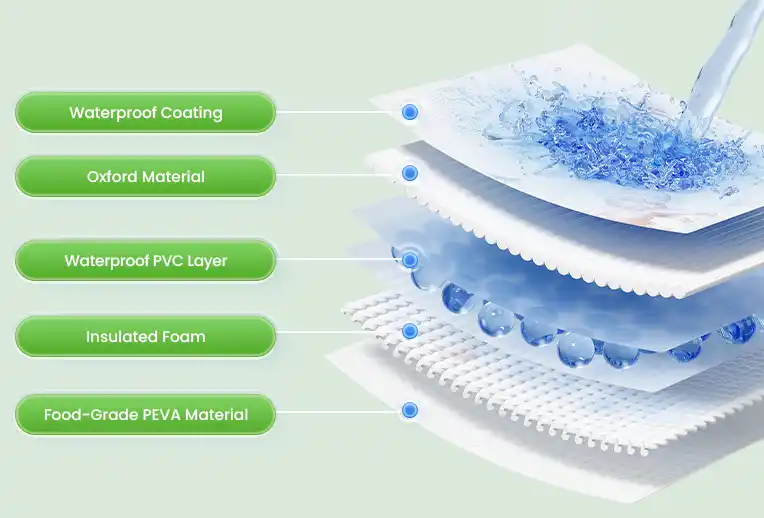
- The Outer Shell: Usually high-denier polyester or nylon, designed to resist abrasion and provide the first layer of UV protection.
- The Insulation Core: Ranging from 5mm to 15mm EPE or NBR foam, this is the engine of the bag that dictates its R-value (thermal resistance).
- The Inner Lining: PEVA or TPU materials are preferred for their food-safety ratings and ability to be heat-welded rather than sewn.
3. Material Excellence: Why Your Choice of Cooler Bag China Factory Matters
3.1 Exploring Nylon Cooler Bag vs. Polyester: Durability and R-Value
When sourcing from a cooler bag china manufacturer, the choice of face fabric determines the bag’s lifespan. A nylon cooler bag offers superior tensile strength and a softer hand-feel, which is often preferred for high-end retail. In the 2026 bulk procurement sector, 600D and 900D Polyester are engineered for Dimensional Stability and structural endurance. Beyond cost-efficiency, the tight fabric density functions as a Secondary Convective Barrier. By neutralizing Wind-Driven Convection, the shell prevents external air currents from stripping away internal thermal energy. This architectural layering ensures that the bag maintains its Thermal Profile even in high-velocity environments, providing a robust defense against rapid heat flux that standard low-density textiles cannot withstand.
3.2 Thermal Lined Cooler Bag: The Importance of Heat-Welded Seams
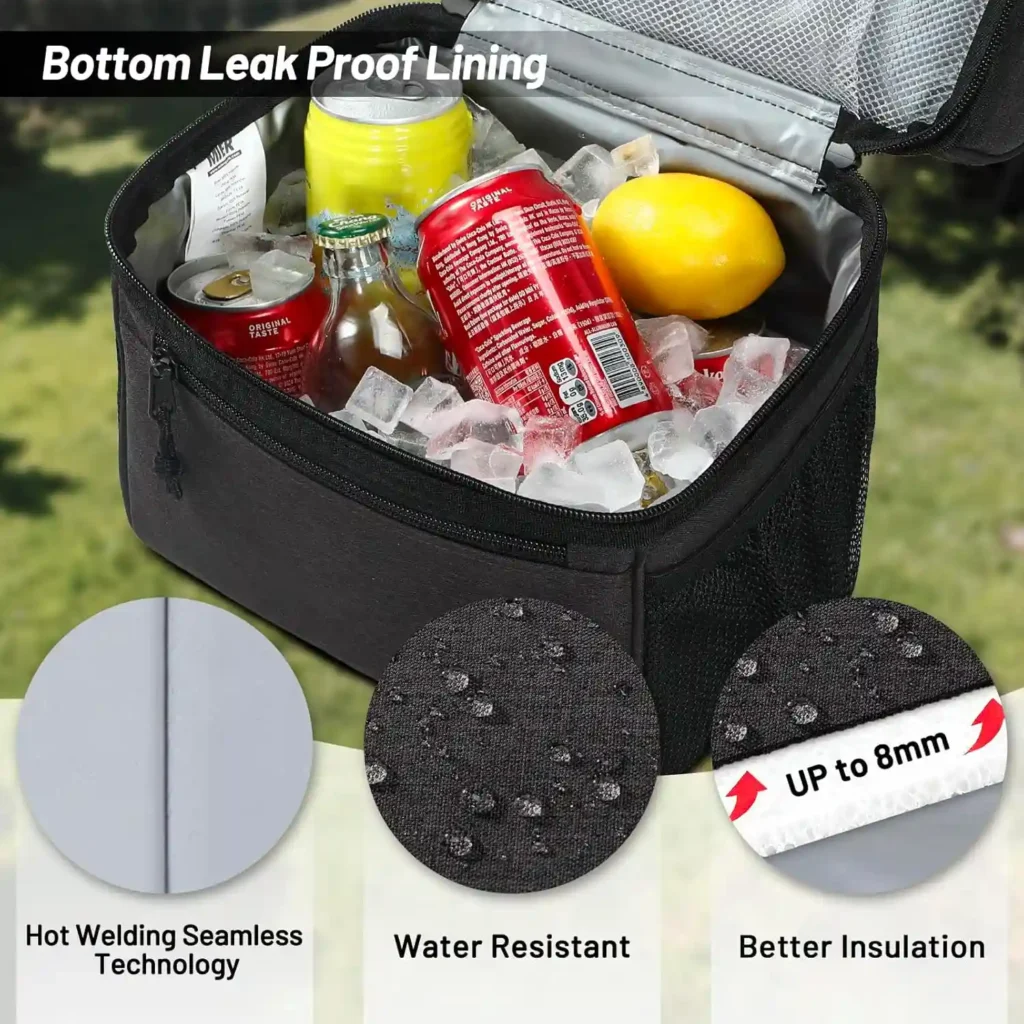
A true thermal lined cooler bag must address the “stitching problem.” Standard coolers fail because “stitched-in” liners inevitably leak melted ice and allow cold air to “wick” out through needle holes—a primary Mechanical Failure Point. We’ve engineered out this issue by implementing RF Welding Technology, which bonds the lining at the molecular level. This creates a 100% Airtight Barrier that prevents internal air exchange. By keeping the insulation foam completely isolated from the environment, we ensure its Cellular R-value remains at peak efficiency, delivering a verifiable “leak-proof” experience for high-end brands.
4. The Professional Sourcing Landscape: OEM, ODM, and Private Label
4.1 Navigating the Soft-Sided Cooler Manufacturer Workflow
The relationship with a soft-sided cooler manufacturer should be collaborative. In a cooler bag oem model, the factory executes the client’s precise blueprints, requiring high-precision cutting and consistent foam density. An cooler bag odm approach leverages the factory’s existing R&D, utilizing proven patterns that have already passed stress tests for weight distribution and thermal longevity. For most brands, the ODM path reduces time-to-market while ensuring the structural integrity of the cooler.
4.2 Tailored Branding: Cooler Bag Private Label and White Label Services
For startups, cooler bag private label services offer a way to enter the market with low R&D overhead. This involves selecting a “white label” design—a pre-engineered, high-performance bag—and applying custom branding.
- Branding Options: Silk-screen printing, heat-transfer, or embroidered patches.
- Hardware Customization: Selecting specific zipper pullers or buckles to differentiate the brand aesthetic.
5. Specialized Medical Solutions: Sourcing an Insulin Cooler
5.1 Precision Control: The Rise of the Portable Insulin Vaccine Cooler Bags
Medical logistics demand a much higher degree of precision than recreational use. For medical-grade logistics, maintaining the Strict 2°C to 8°C Range is a function of Protein Stabilization. Our 2026 insulin cooler series utilizes High-Density NBR (Nitrile Butadiene Rubber) to provide superior thermal stability compared to commodity foams. By architecting a Multi-Layered Reflective Infrastructure, we neutralize Radiant Heat Flux, bouncing external energy away from the sensitive cargo. This high-integrity barrier ensures that the internal Micro-Thermal Environment remains constant, preventing the molecular degradation of critical biological payloads.
5.2 Engineering the Travel Medicine Cooler Bag for Global Compliance
A travel medicine cooler bag is often a life-saving piece of equipment. When designing a cooler bag for medicine, compliance with international standards for “cold chain” integrity is non-negotiable. These bags often feature built-in temperature monitors or transparent pockets for prescription documentation, ensuring that the patient can pass through customs while keeping their medication at the required efficacy temperature.
6. Outdoor & Leisure: The Versatility of the Cooler Backpack
6.1 Hands-Free Efficiency: The Cooler Backpack Factory Standard
The shift toward the cooler backpack has been one of the most significant trends in leisure sourcing. A cooler backpack factory must prioritize ergonomics as much as insulation. Standard bags fail when “surface stitching” pulls through the fabric under 15kg of tension—a major Mechanical Failure Point. We’ve engineered out this weakness by implementing Internal Backing Plates combined with industrial-grade X-box reinforcements. This ensures the Load-Bearing Anchors distribute force across the 1680D chassis rather than focusing it on a single thread. By keeping the load close to the user’s center of gravity, we prevent “lever-effect” strain, delivering a Heavy-Duty Mobility Solution that remains comfortable and durable under peak capacity.
6.2 Picnic Perfection: Designing the Ultimate Picnic Cooler Bag
A picnic cooler bag or backpack cooler bag often requires internal compartmentalization. This prevents delicate food items from being crushed by heavy beverage cans.
- Dual-Zone Design: Many high-end models feature a “dry” top compartment for bread and fruit, and a “wet” bottom compartment for ice and drinks.
- External Utility: Integrated bottle openers and elasticized gear loops add functional value for the end-user.
7. Beverage Optimization: Beer Cooler and Drink Coolers Wholesale
7.1 Beer Cooler Factory Insights: Maintaining the Perfect Serving Temp
In the beer cooler factory, the focus is on “can capacity” and vertical insulation. A dedicated beer cooler is sized specifically for standard 12oz or 16oz cans to minimize “dead air” space, which is the enemy of cold retention. When the bag is full of cans, the thermal mass of the beverages helps maintain the temperature, but the insulation must be thick enough to prevent the “sweating” (condensation) on the exterior of the bag.
7.2 Sourcing Portable Drink Cooler Options for Global Distribution
When dealing with drink coolers or a portable drink cooler at a wholesale level, the “Impressions per Dollar” is a key metric.
| Feature | Benefit | Wholesale Consideration |
| PVC-Free Lining | Market Compliance | Essential for EU/US markets |
| Collapsible Design | Logistics | Reduces CBM for sea freight |
| Antimicrobial Coating | Longevity | Prevents mold in humid climates |
8. B2B Bulk Sourcing: Finding a Reliable Cooler Bag Wholesaler
8.1 Strategies for Soft-Sided Cooler Bulk Procurement
Successfully managing soft-sided cooler bulk orders requires a deep dive into the factory’s quality control (QC) protocol. A reliable cooler bag wholesaler should provide AQL (Acceptable Quality Level) inspection reports before shipment. For bulk orders, the consistency of the insulation foam is the most common point of failure; if the factory uses scrap foam, the thermal performance will vary significantly between units in the same batch.
8.2 Evaluating a Cooler Bag Exporter: Shipping and CBM Optimization
An experienced cooler bag exporter understands that they are essentially “shipping air” due to the bulkiness of the foam. Cooler bag sourcing should involve a discussion on vacuum-packing or “flat-pack” engineering. By compressing the bags during transit, you can significantly increase the quantity per container, reducing the landed cost per unit.
9. High-Performance Standards: Leakproof Soft Cooler & UV Resistance
9.1 The Tech Behind a Leakproof Cooler Bag and Waterproof Seals
In the high-end market, Hydrostatic Integrity is the ultimate benchmark. A true Leakproof Soft Cooler requires a Hermetic Enclosure Logic that mirrors dry-suit technology. By utilizing Airtight/Waterproof Zippers—engineered with thermoplastic polyurethane (TPU) teeth and gaskets—we eliminate atmospheric and fluid exchange. This construction ensures that even under inverted pressure, the Structural Hermeticity remains absolute. Achieving this level of performance requires specialized Heat-Welded Seam Integration, transforming a simple cooler into a 100% integral pressure vessel.
9.2 Why UV Resistant Cooler Bag Materials are Crucial for Beach Environments
The uv resistant cooler bag is designed for the harsh exposure of coastal environments. Sunlight doesn’t just heat the bag; it degrades the polymers in the fabric. By using UV-stabilized coatings on the outer shell, the bag resists fading and material embrittlement. This ensures that the bag remains a functional asset for multiple seasons rather than becoming a “single-summer” disposable item.
10. The Professional Food Service: Thermal Food Delivery Bag
10.1 Sourcing from a Thermal Bag Manufacturer for Commercial Use
A Thermal Food Delivery Bag is an industrial tool that must withstand 20 to 30 opening-closing cycles per day. A professional thermal bag manufacturer focuses on “Cyclic Durability”—using oversized zippers and reinforced webbing. The insulation is often a hybrid of EPE foam and reflective aluminum foil to keep hot food above the safety threshold of 60°C during the “last mile” of delivery.
10.2 Antimicrobial Cooler Bag Linings: A 2026 Trend in Food Safety
Standard cooler liners fail because they become porous environments for Bio-Film Accumulation. We’ve engineered out this Mechanical Failure Point by specifying linings treated with Ag+ (Silver Ion) Bio-Defense. Unlike topical sprays, this treatment is embedded into the substrate to prevent “wash-out” during cleaning. This ensures that even when the bag remains damp between shifts, the lining actively repels odor-causing bacteria. We provide Product Managers with a Professional-Grade Hygiene Shield that stands up to the rigors of health inspections and heavy-duty use.
11. Practical Alternatives: What to Use Instead of a Cooler Bag?
11.1 How to Make a Makeshift Cooler Bag for Temporary Use
When asked what to use instead of a cooler bag, the answer lies in understanding insulation layers. You can make a makeshift cooler bag by wrapping items in multiple layers of aluminum foil (to block radiation) and then several layers of thick wool or towels (to block conduction). However, these solutions lack the “air-gap” consistency of a professional product and are only suitable for very short durations.
11.2 Comparing Professional Gear vs. How to Keep Something Cold Without a Cooler Bag
People often search for how to keep something cold without a cooler bag, suggesting methods like burying items in the sand or using wet burlap sacks. While these utilize evaporative cooling, they are vastly inferior to the 24-hour retention of a high-R-value soft cooler. Professional gear provides a predictable, repeatable thermal environment that “do-it-yourself” methods simply cannot replicate in professional or medical contexts.
12. Conclusion
Selecting a cooler bag is not just about choosing a container; it is about choosing a temperature control solution. Whether you are dealing with a Custom cooler bag or a large-scale Cooler bag export, quality is the non-negotiable core.
Expert Insight: The 2026 market is rapidly evolving toward the Easy clean cooler bag and Sustainable materials, where performance must coexist with environmental responsibility.