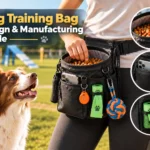
A dog treat pouch may look like a simple pet accessory. But making a good one that works well during daily training takes more thought than choosing a fabric and adding a belt clip.
The opening needs to be easy to access, the lining should be practical to clean, and the pouch must stay comfortable when the user walks, bends, or runs. For pet brands, there are other considerations too: production costs, material consistency, customization, and whether the design can be reproduced reliably in bulk.
At Aimazing Bag, we approach pet accessory development from both a manufacturing and a product-use perspective. With bag manufacturing experience dating back to 2000, we understand that even small construction details can affect the finished product.
In this guide, we’ll share what brands and wholesale buyers should consider when developing a custom treat pouch, from material selection and magnetic closures to sampling and quality control.
1. What Makes a Well-Designed Dog Treat Pouch? A Manufacturer’s Perspective
A good dog treat pouch should make training easier, not give the handler another thing to worry about.
Imagine someone working with a dog in a busy park. They need to reach for a reward with one hand while keeping their attention on the animal. If the pouch opening collapses, the treats are difficult to reach, or the belt clip keeps shifting, even a well-made bag can become frustrating.
This is why we encourage brands to review how the product will actually be used before finalizing its appearance.
Three design details deserve particular attention:
- Opening structure: A wide, accessible opening allows treats to be retrieved without unnecessary fumbling. The edge may need reinforcement to maintain its shape.
- Lining and cleanability: Smooth interior surfaces are generally easier to wipe down after handling oily or moist treats.
- Attachment stability: Belt clips, waist straps, and reinforced loops help keep the pouch in a comfortable position during movement.
Material thickness and pouch geometry also matter. A bag that is too deep can slow down treat retrieval, while a very shallow design may not hold enough rewards for a longer training session.

From a manufacturing perspective, the goal is to find the right balance rather than adding as many features as possible.
Our recommendation: Before approving a sample, fill the pouch with a realistic amount of treats and try retrieving them with one hand. A simple hands-on check can reveal design problems that are difficult to identify from drawings alone.
2. Dog Treat Pouch vs. Dog Treat Bag: Choosing the Right Design for Your Market
The terms dog treat pouch and dog treat bag are often used interchangeably, but the intended customer can influence the best design.
A compact treat bag for everyday walks does not necessarily need the same opening structure, storage capacity, or attachment system as a pouch used by professional dog trainers.
For brands developing a new product line, we suggest deciding on the target customer before choosing materials or accessories.
| Product Type | Typical Customer | Recommended Design Features |
|---|---|---|
| Everyday Dog Treat Bag | Pet owners and retail customers | Lightweight fabric, compact shape, easy-clean interior |
| Professional Training Pouch | Dog trainers and training schools | Wide opening, quick access, stable waist attachment |
| Multi-Function Training Pouch | Outdoor users and pet accessory brands | Additional compartments, accessory storage, reinforced construction |

Why Product Positioning Matters
A simple walking pouch may only need one treat compartment and a secure clip. This keeps the product lightweight and helps control manufacturing costs.
A professional training model may benefit from a magnetic closure, a structured opening, or separate pockets for clickers and waste bags.
However, additional features also introduce more materials, hardware, and assembly steps.
When discussing OEM projects, we recommend comparing these features against the brand’s expected retail price and target audience.
For example, if the product is intended for entry-level pet retail, investing in a more practical lining may offer greater customer value than adding several decorative pockets.
The best design is not always the most complicated one. It is the one that suits the people who will use it.
3. Choosing Easy-Clean Liners and Food-Contact Materials for Dog Treat Pouches
Treat pouch interiors are exposed to crumbs, oils, and sometimes moisture from soft training rewards.
For that reason, we believe the lining deserves just as much attention as the exterior fabric.
Some brands focus heavily on outer materials because these are what customers notice first. However, the inner surface often has a greater influence on everyday cleaning and maintenance.
PEVA vs. TPU: Which Lining Makes More Sense?
Both PEVA and TPU-based materials can be considered for dog treat pouch interiors, depending on the required construction and intended use.
| Material | Practical Advantages | Points to Consider |
|---|---|---|
| PEVA | Flexible, smooth surface, available in various specifications | Performance depends on material formulation, thickness, and seam construction |
| TPU | Flexible, abrasion-resistant options, suitable for certain laminated or welded constructions | Usually requires closer evaluation of processing method and cost |
| Coated Polyester | Can be practical for dry-treat compartments and simple designs | Coating durability and ease of cleaning depend on the specific material |
For brands developing an everyday pouch, an easy-clean lining may be more important than using a particularly expensive outer fabric.
The construction method also needs attention. Stitched lining panels are common and practical, but their seams can collect crumbs or moisture. A removable liner may make cleaning easier, while certain compatible thermoplastic materials can support welded construction.
Not every design requires welded seams, and not every material is suitable for that process.

What About Food-Contact Requirements?
If treats will come into direct contact with the lining, material suitability should be confirmed for the intended application.
For products sold in the United States or European markets, brands should review the relevant food-contact requirements and obtain appropriate material documentation or testing where necessary.
A material described simply as PEVA or TPU is not automatically suitable for every food-contact use.
At Aimazing, we recommend clarifying this requirement during material selection, before the final sample is approved.
That helps brands avoid changing materials late in development, when alterations can affect cost, construction, and production schedules.
4. Dog Training Treat Pouch Design: Magnetic Closures and Smart Compartments
One of the most important decisions when developing a dog training treat pouch is how the opening should work.
Dog handlers often need to retrieve rewards quickly and repeatedly. A closure that requires both hands can interrupt training, but an opening that is too loose may allow treats to spill.
This is why we recommend a magnetic treat pouch that offers a practical option.
Are Stronger Magnets Always Better?
Not necessarily.
The performance of a magnetic opening depends on more than magnet strength.
We recommend considering:
- Magnet positioning: The magnets should align consistently when the pouch closes.
- Opening stiffness: The surrounding fabric and reinforcement affect how easily the opening separates.
- One-handed access: The user should be able to retrieve treats without struggling against excessive closing force.
- Closure security: The opening should remain sufficiently secure during normal movement.
A stronger magnet may improve retention, but it can also make the pouch more difficult to open.
For a custom magnetic treat pouch, we suggest testing different closure arrangements during sampling rather than choosing hardware based only on strength specifications.

Compartment Design Should Follow Actual Use
Not every dog training bag needs multiple compartments.
A simple design may work well with one main treat chamber and a small external pocket. More specialized models can include separate storage for clickers, waste bags, or other training accessories.
| Component | Purpose | Manufacturing Consideration |
|---|---|---|
| Main Treat Chamber | Quick access to rewards | Opening width, depth, lining |
| Zipper Pocket | Secure accessory storage | Zipper position and usability |
| Mesh Pocket | Holds lightweight training items | Mesh strength and attachment |
| Waste Bag Dispenser | Convenient bag access | Opening placement and edge reinforcement |
One detail we often encourage brands to consider is whether additional compartments will interfere with treat access.
A crowded pouch may look versatile in product photos but feel less practical during training. Keeping the main compartment simple and easy to reach is often the better starting point.
5. Waterproof Treat Pouch Materials: Balancing Protection, Durability, and Cost
A waterproof treat pouch may sound ideal for outdoor training, but brands should distinguish between water-resistant materials and a fully waterproof finished product.
These are not the same thing.
A coated polyester or nylon fabric may resist light rain, while water can still enter through stitching holes, seams, or the bag opening.
For many everyday pet accessories, water resistance combined with an easy-clean lining may provide a sensible balance between performance and cost.
Common Material Options
Coated polyester: A practical option for many retail-oriented products. It is available in a wide range of colors and specifications.
Coated nylon: Can provide a different balance of weight, hand feel, and abrasion resistance, depending on the construction.
TPU-laminated fabric: Worth considering for designs that need a more substantial moisture barrier, provided the seams and closure system are designed accordingly.

What Should Buyers Check?
If a brand plans to market its product as waterproof, the finished construction should be assessed, not just the fabric specification.
We suggest reviewing seam treatments, opening design, and the intended exposure conditions before making waterproof performance claims.
For ordinary walking and training applications, a water-resistant exterior may be sufficient.
A product intended for prolonged exposure to heavy rain may require a different construction approach and additional testing.
Our advice is to specify the actual use conditions first, then choose the material and construction.
This helps prevent unnecessary material costs and avoids promising performance that the finished bag has not demonstrated.
6. Belt Clips, Waist Straps, and Ergonomic Design for Dog Treat Pouches
A treat pouch needs to remain accessible while the user moves. Even a well-designed compartment can become inconvenient if the bag rotates, bounces excessively, or sits in an uncomfortable position. Attachment design is therefore an important part of product development.
Choosing the Right Attachment System
Three options are commonly worth considering.
Belt clips are convenient for compact designs and allow users to attach or remove the pouch quickly. Clip material, strength, and compatibility with different belt thicknesses should be reviewed.
Adjustable waist straps help distribute the load and can provide a more secure fit for active training situations.
Reinforced belt loops offer a simple alternative with fewer detachable components, although users may find them less convenient to remove.
Some designs combine attachment methods to give customers more flexibility. However, more hardware does not automatically improve comfort. The pouch’s shape, loaded weight, and attachment position all affect stability.

Test the Pouch When It Is Full
One common oversight in bag development is evaluating the sample only when it is empty. A loaded pouch behaves differently.
Treats add weight, and accessories may change the way the bag hangs against the body.
For this reason, we recommend checking whether the pouch tilts forward, whether the attachment points remain stable, and whether the opening is still easy to reach.
Reinforced stitching at high-stress areas is also worth discussing during sampling.
Small improvements to the attachment structure can make a noticeable difference in everyday use without requiring a complete redesign.
7. How We Approach Dog Treat Pouch Durability and Quality Control
For pet brands, product quality is about more than receiving a sample that looks attractive.
The design needs to remain consistent when production moves from a single approved sample to a larger order.
At Aimazing, we work with a quality control process covering incoming materials, production, finished products, and outgoing inspection.
For a treat pouch project, we recommend focusing particular attention on the areas that experience repeated handling.
Key Quality Control Areas
| Inspection Area | What to Check | Why It Matters |
|---|---|---|
| Fabric and Lining | Consistency, visible defects, coating condition | Affects appearance, cleaning, and durability |
| Stitching | Seam consistency and reinforced stress points | Helps reduce the risk of seam failure |
| Closure System | Opening and closing performance | Affects accessibility and treat retention |
| Belt Attachments | Secure stitching and hardware installation | Supports stable everyday use |
| Finished Product | Dimensions, appearance, function | Helps maintain consistency with the approved sample |
Why Sampling Matters
A sample provides an opportunity to identify practical issues before bulk production.
For example, a belt clip may appear well-positioned in a drawing but interfere with the pouch opening when worn. A lining may look suitable at first but prove difficult to clean around the corners.
These are the details worth checking early.
We recommend reviewing the sample with the intended use in mind rather than approving it based only on appearance.
For projects requiring additional performance testing, the inspection method and acceptance criteria should be agreed upon in advance.
The right testing approach depends on the materials, product construction, and target market.
The purpose of quality control is not to promise that no product will ever have a problem. It is to identify avoidable issues and improve production consistency.
8. Custom Dog Treat Pouch OEM: From Design Concept to Bulk Production
Developing a custom pet accessory does not always start with a complete technical drawing.
Some brands already know the exact size, fabric, and closure they want. Others have a reference product and a few ideas about what they would like to improve.
Both can be good starting points.
As a pet bag manufacturer and development partner, Aimazing helps customers review their designs from a practical production perspective.
That includes discussing material choices, product structure, branding, and how different features may affect manufacturing costs.
Step 1: Share Your Product Idea
A sketch, reference photo, technical drawing, or existing sample can help explain the concept.
At this stage, useful information includes the intended customer, desired features, estimated order quantity, and target price.
Knowing the intended retail market also helps guide material selection.
Step 2: Review Materials and Construction
Before sampling, the main design choices should be discussed.
For a dog pouch for treats, these may include:
- Outer fabric and lining
- Magnetic, drawstring, or zipper closure
- Belt clips and adjustable straps
- Internal compartments
- Custom logos, labels, and packaging
We also recommend identifying features that may add production complexity without offering much value to the intended customer.
This helps keep the product aligned with the brand’s budget.
Step 3: Make and Evaluate the Sample
At Aimazing, sampling typically takes 3–5 days for applicable designs, depending on the required customization and material availability.
The sample provides an opportunity to evaluate the pouch’s size, appearance, opening, and attachment system.
If adjustments are needed, they can be discussed before moving toward final production approval.
Step 4: Confirm the Pre-Production Sample
Once the design has been refined, the approved specifications and pre-production sample provide a reference for bulk manufacturing.
Details such as fabric color, logo placement, hardware, dimensions, and packaging should be confirmed clearly.
Step 5: Bulk Production and Quality Control
Aimazing offers OEM/ODM bag manufacturing with an MOQ starting from 100 pieces.
Production planning depends on the selected materials, order quantity, customization requirements, and approved specifications.
Throughout the process, our goal is to help customers move from a product concept to a design that can be manufactured consistently.
We see our role as more than producing the bag. We want to help brands make informed product decisions before those decisions become expensive to change.
9. Dog Treat Pouch OEM Sourcing Checklist for Pet Brands and Wholesalers
Before requesting a quotation, it helps to prepare a few key details.
You do not need to have every specification finalized, but the clearer your requirements are, the easier it is for a manufacturer to recommend a suitable solution.
| Sourcing Question | What Buyers Should Consider |
|---|---|
| Who is the target customer? | Everyday pet owners, professional trainers, or outdoor users? |
| What opening is preferred? | Magnetic, drawstring, or zipper? |
| What treats will the pouch hold? | Dry kibble, soft treats, or oily rewards? |
| Does the lining require direct food-contact suitability? | Review the intended use and target-market requirements |
| How will the pouch be carried? | Belt clip, waist strap, or multiple attachment options? |
| What branding is required? | Printed logo, woven label, embroidery, or custom packaging? |
| What is the target price? | Balance material costs, functionality, and expected retail positioning |
| What is the order plan? | Quantity, sampling requirements, and delivery expectations |
A Final Tip From a Manufacturing Perspective
When comparing suppliers, don’t evaluate the quotation alone.
Ask whether the manufacturer can explain why a particular material or construction method is suitable for your design.
A reliable bag manufacturing partner should be able to discuss practical alternatives, identify possible production challenges, and explain how design choices affect costs.
This is particularly useful for new pet brands that are still developing their first product line.
Frequently Asked Questions About Dog Treat Pouch Development
What makes a good dog treat pouch?
A good dog treat pouch combines easy access, practical cleaning, and secure attachment. The opening should allow comfortable treat retrieval, while the interior should be suitable for the type of rewards being carried. Material durability and construction quality also matter, especially for products used regularly during training.
For brands developing a new design, we recommend evaluating these features together rather than selecting materials based only on appearance.
Are magnetic treat pouches secure?
A magnetic treat pouch can provide convenient one-handed access while helping keep the opening closed during normal use. However, security depends on magnet placement, closure design, fabric thickness, and how the pouch is carried.
A magnetic opening should be evaluated with a realistic load during sampling. If the intended use involves vigorous activity, an additional closure feature may be worth considering.
How do I choose the right size for a custom dog treat pouch?
The ideal size depends on the target customer and intended training activity.
A compact pouch may suit everyday walks, while a larger design can be useful for extended training sessions.
We recommend evaluating how much the pouch needs to hold, how easily a hand can reach inside, and whether the filled pouch remains comfortable to wear.
A physical sample is often the simplest way to confirm these details.
Can treat pouches hold wet or oily treats?
Some treat pouches are designed to accommodate moist or oily rewards, but the lining material and construction must be suitable for the intended use.
Smooth, easy-clean surfaces can make maintenance more convenient. Removable liners may also be considered for certain designs.
Brands should verify relevant food-contact requirements when treats will directly touch the lining, and provide appropriate cleaning instructions for the finished product.
Which attachment system works best for dog training treat pouches?
Belt clips are convenient for quick attachment, while adjustable waist straps may provide better stability during active training.
Reinforced belt loops offer another practical option.
The best choice depends on the pouch size, expected load, and customer preference. Testing the product while worn and filled with treats is recommended before finalizing the attachment system.
What lining materials are recommended for custom dog treat bags?
PEVA and TPU-based materials are among the options worth considering for easy-clean treat pouch interiors.
Their suitability depends on the product design, required performance, intended food contact, construction method, and budget.
Brands should review material specifications and relevant compliance documentation rather than assuming every material in a general category provides the same performance.
Can I customize a dog treat pouch with my brand logo and packaging?
Yes. Aimazing provides OEM/ODM customization for pet accessory projects, including material selection, bag structure, logo applications, labels, and packaging.
Our MOQ starts from 100 pieces, with sampling typically available in 3–5 days for applicable designs.
You can begin with a drawing, an existing sample, or a product idea. Our team can discuss the available customization options and help develop a practical manufacturing solution.
Develop Your Custom Dog Treat Pouch with Aimazing
A successful dog treat pouch does not need every feature on the market. It needs the right combination of usability, materials, construction, and price for the customers it is designed to serve.
At Aimazing Bag, we work with pet brands, wholesalers, and distributors to develop custom bag products that reflect their market needs.
Whether you are improving an existing design or planning a new product line, our team can help you explore construction options, review materials, and prepare for production.
Have a dog treat pouch idea you’d like to develop?
Share your reference photos, drawings, or product requirements with us. Let’s discuss how to turn your idea into a practical, production-ready design.
Aimazing Bag — Your Bag Manufacturer & Development Partner