1. Introduction
Forget the old “lunch box”—modern lunch totes have evolved into climate-controlled systems. In 2026, it’s not just about carrying food; it’s about Professional Aesthetics and keeping your meals at the perfect temperature all day. We’ve moved past cheap plastic to material innovation that looks like a high-end office bag but works like a high-tech cooler. It’s the ultimate gear for the professional who values both health and style.
2. Evolution of Thermal Materials: Eco-Friendly Lunch Bags for Adults
2.1 Beyond Traditional Fabrics: Utilizing Sustainable RPET in Lunch Totes
The 2026 landscape is all about GRS-certified RPET. We’ve seen a technological revolution where the tensile strength of recycled fibers now rivals virgin polymers. Value Reconstruction Beyond the ‘Green’ Label. Evolution Without Compromise. The core of premium positioning lies in our ability to utilize recycled fibers—like RPET or bio-based nylons—to replicate that “silky, plump, and high-dampening” luxury feel. Through advanced soft-finishing techniques, we eliminate the typical coarseness of recycled substrates, ensuring the product delivers a premium visual and tactile aesthetic suitable for high-end professional settings. This technical moat provides absolute leverage when facing the most discerning high-net-worth B2B clients who refuse to sacrifice quality for sustainability.
2.2 The Shift from Disposable to Durable Reusable Lunch Bags
We are seeing a decisive market pivot toward reusable meal management. Lowering ‘Cost-Per-Use’ via Premium Manufacturing. Consumers now recognize that an RPET puffy bag lasting over 5 years offers far superior cost-efficiency compared to frequent low-end replacements. By delivering “resilient” products, brands reduce landfill waste while fostering a loyalty rooted in trust. This is more than ESG compliance; it is the strategic high ground in the 2026 competitive landscape.
- Lifecycle Longevity: Micro-managing Structural Fatigue. Surviving over 1,000 use cycles—equivalent to roughly three years of high-frequency daily use—demands extreme physical stress testing during R&D. This involves tear-resistance validation for HF Welded Seams, ten-thousand-turn zipper endurance trials, and advanced anti-pilling and abrasion-resistant treatments. Such industrial engineering ensures that after hundreds of loading, washing, and environment-shift cycles, the bag maintains its peak thermal efficiency and structural integrity.
- Material Integrity: From localized stress to holistic support. High-density weaves offer more than just aesthetics; they optimize the stress distribution logic of the pack. When the textile itself possesses superior structural stability, weight is distributed more evenly across the shell to the straps and suspension system, preventing seam failure caused by localized over-stretching. This “internal skeleton” characteristic extends the fatigue life of the bag under high-frequency loading—a key technical metric for “industrial-grade durability” in 2026.
- Waste Reduction: Driving behavioral change through tools. Modern corporations are pivoting away from low-value, ephemeral giveaways, prioritizing food transport gear with industrial durability. By gifting professional insulated bags designed for 1,000+ use cycles, companies are essentially providing employees with a plastic-reduction solution. This gift is more than a material reward; it’s a statement of “environmental credibility,” transforming corporate culture from slogans into daily low-carbon practices by minimizing the circulation of single-use containers and plastic bags in the office.
3. Leakproof Engineering: Best Leakproof Lunch Bag That Doesn’t Smell
3.1 Heat-Welded Technology: Why a Leak Proof Lunch Bag is Essential
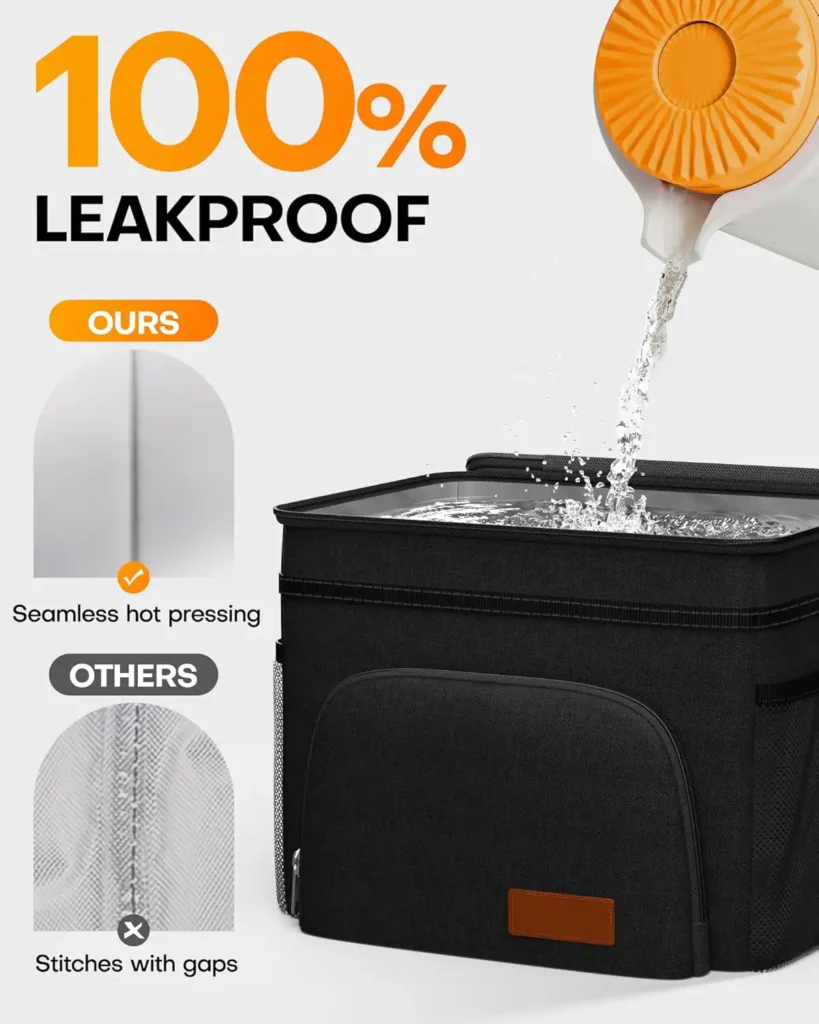
The distinction of being the best leakproof lunch bag that doesn’t smell lies in the elimination of traditional stitching in the interior liner. Utilizing ultrasonic or high-frequency heat-welding, a professional insulated lunchbag creates a seamless, 3D internal tub. This leak proof lunch bag technology ensures that spilled liquids remain contained within the thermal compartment, protecting expensive electronics and documents typically found in a professional’s commute. For best insulated lunch bag for adults 2026 standards, a liner must pass a 24-hour immersion test without a single drop of seepage through the bottom seams.
3.2 Antimicrobial Linings: Solving the “Smelly Lunch Bag” Pain Point
Odor retention is the primary reason consumers discard their lunch gear, a problem solved by 2026’s advanced antimicrobial lining technology.
-
- Microbe Resistance: Linings are infused with zinc or silver-ion agents that inhibit the growth of mold and bacteria in damp, dark environments.
- Low-Surface Energy: TPU or PEVA liners are formulated to prevent oils from bonding to the surface, allowing for a 99% reduction in residue after a simple wipe.
- Chemical Neutralization: Specialized materials actively break down organic compounds that lead to the traditional “sour” smell found in aged lunch bags.
4. Functional Design for Men: Sourcing the Best Lunch Bags for Men
4.1 Rugged Durability: Tactical Lunch Cooler for Construction Workers
Unlike women or kids lunch bags, ourcing a lunch bag for men in industrial sectors requires a shift toward heavy-duty specifications. For heavy-industrial sectors, we engineer coolers using 1680D Ballistic Nylon to ensure maximum impact and abrasion resistance. The integration of a reinforced molded EVA base provides a critical barrier against hydrostatic pressure on damp job sites. To meet the ergonomic needs of construction and mining professionals, we utilize oversized gauge zippers and high-tensile metal hardware, ensuring seamless operation with PPE (personal protective equipment). This is a high-performance industrial tool designed for zero-failure in the most abrasive environments.
4.2 High Capacity Sourcing: Mens Lunch Box Cooler with Multi-Compartments
A high-performance mens lunch box cooler must accommodate more than just a single meal; it serves as a daily mobile station for the long-shift worker.
- Zonal Organization: Separate dry compartments for phones and keys isolate electronics from the humid cold zone of the food compartment.
- Volume Management: Large capacity models are designed to fit multiple standard meal prep containers plus 1.5L water bottles without structural deformation.
- External Attachments: Integrated webbing systems allow for the attachment of additional pouches or carabiners, a feature highly sought after in the 2026 male consumer demographic.

5. Aesthetic & Utility for Women: Stylish Lunch Bags for Ladies
5.1 Professional Chic: Sourcing the Elegant Lunch Bag for Office Use
The demand for stylish lunch bags for ladies has transformed the category into “fashionable utility.” An elegant lunch bag for the 2026 office environment must mimic the silhouette of a high-end handbag while concealing a high-performance thermal core. Sourcing managers now look for vegan leathers or premium textured weaves that do not “advertise” the contents as food. This insulated lunch tote bag aesthetic allows a professional woman to transition from the boardroom to a commute without the clunky appearance of a traditional cooler.
5.2 Portable Convenience: Lunch Box Bag for Ladies with Shoulder Straps
Ergonomics are paramount in the design of a lunch box bag for ladies, especially for multi-modal commuters.
- Modular Straps: Removable, padded shoulder straps offer multiple carry modes, including crossbody or handheld options for maximum flexibility.
- Hardware Finish: High-gloss or matte metal accents provide a luxury feel without compromising the bag’s ability to carry 5kg+ loads.
- Weight Distribution: The internal skeletal structure is designed to keep the bag balanced even when carrying heavy glass meal containers.

6. High-Performance Temperature Control: Insulated Lunch Tote That Keeps Food Hot
In the 2026 sourcing landscape, “good enough” is no longer the standard. Professionals demand precise meal management. As a manufacturer with 26 years of experience, we have optimized our thermal baseline to focus on Conductive and Radiant resistance using a reinforced 8mm architecture.
6.1 The Engineering Logic: Zero-Degree Defense
Our system utilizes a dual-layer approach to defeat the laws of cooling:
- Radiant Heat Management: The internal lining consists of an aluminum foil laminate with a high emissivity rating. By reflecting 97% of radiant heat back toward the source, we ensure the core temperature of the meal remains stable for extended durations, even in sub-zero external environments.
- Conductive Thermal Barrier (8mm EPE): This is the core differentiator of our production line. We utilize 8mm High-Density EPE (Expanded Polyethylene) as the primary insulator.
- Superior R-Value: By increasing the foam thickness to 8mm, we significantly raise the thermal resistance (R-value). This slows the rate of heat transfer through the bag walls far more effectively than standard 3mm or 5mm alternatives.
- Structural Resilience: The 8mm profile adds physical rigidity to the bag’s chassis. This ensures that the insulation layer does not compress under the weight of heavy glass containers, preventing “thermal bridges” where heat usually leaks out.
Strategic Advantage for 2026 Brands: This reinforced 8mm EPE solution offers a high-performance value proposition without the prohibitive cost of vacuum panels. It is the ideal technical standard for brands targeting the professional outdoor, construction, or executive commuter markets. We deliver a stable thermal barrier that honors your brand’s promise of quality.
6.2 Maintaining Heat: Structural Analysis of a Lunch Bag to Keep Food Warm
The efficacy of a lunch bag to keep food warm is determined by its air-tightness and lid closure design.
| Component | Function | Material Standard |
| Gasket Zipper | Prevents air exchange | Waterproof TPU coated |
| Inner Lining | Heat reflection | Aluminum Foil laminate |
| Lid Seal | Overlap flap | Double-insulated lid |
| Warmth Duration | 6-8 hours | Maintains >60°C threshold |
A professional lunch bag warmer setup ensures that a meal remains above the safety threshold until the midday break, regardless of the surrounding environment.
7. Cold Chain Excellence: Sourcing the Best Lunch Cooler Bag
7.1 Integrated Cooling: Lunch Bag with Ice Pack Compartment Solutions
The best lunch cooler in 2026 is no longer just a bag; it is a cold-chain solution for the daily commuter. A lunch bag with ice pack functionality often features dedicated internal mesh sleeves to prevent direct contact between the ice pack and the food, which can cause localized freezing. Specialized lunch cooler bag designs now include “dual-phase” cooling zones where different temperatures are maintained in separate areas through varying insulation thicknesses.
7.2 The Ideal Work Cooler Bag: Keeping Perishables Safe All Day
For the long-distance commuter, a work cooler bag must provide 12-hour cold retention.
- Condensation Control: Exterior fabrics are treated with DWR (Durable Water Repellent) to prevent the “sweating” common in humid climates.
- Stability: Reinforced bases ensure the bag does not tip over in a vehicle or on a desk, preventing accidental spills.
- Access Points: Top-loading “doctor bag” style openings allow for a full view of the contents, making it easy to retrieve items without releasing all the cold air.
8. Ergonomic Hands-Free Mobility: The Lunch Box Backpack
8.1 Multi-Tasking Design: Backpack with Lunch Compartment for Commuters
The Art of Center of Gravity.” Placing the lunch zone at the base or in a dedicated lateral compartment is the 2026 standard, keeping weight closer to the user’s center of gravity to reduce shoulder strain during cycling. Through padded back panels with integrated airflow channels, commuters stay cool even when carrying warm meals. By scientifically partitioning the “Dining” and “Work” spaces at a 3:7 or 4:6 ratio, the pack perfectly aligns with modern daily requirements.
- Isolation Tech: The thermal compartment is separated by a rigid, non-porous barrier to ensure that condensation does not affect the electronics in the main compartment.
- Ergonomics: Padded S-curve straps and ventilated back panels prevent discomfort during long walks or active commutes.
8.2 Heavy-Duty Utility: Sourcing the Lunch Box Backpack for Adults
When sourcing a lunch backpack for adults, durability and total capacity take center stage.
- Load Support: Chest straps and hip belts are essential for a lunch backpack cooler that may carry 10kg+ of food and hydration.
- Volume: 25L to 30L total capacity is the industry standard for full-day field workers.
- Safety: Reflective strips are integrated into the design for visibility during early morning or late night travel.
9. Professional Meal Prep: The Meal Prep Lunch Bag
9.1 Organization Mastery: Sourcing a Dual Compartment Lunch Bag
Ending heat conduction for texture preservation. True dual-compartment design requires a Thermal Break within the partition. This means the “Hot Zone” and “Cold/Salad Zone” are not just physically separated but thermally isolated using high-density insulation. This ensures that even when hot staples and chilled juices share the same bag, their temperatures do not fluctuate, preserving the optimal flavor and nutritional integrity at the moment of consumption.
- The “Two-Story” Design: The bottom compartment houses heavy meal prep containers, while the top compartment holds light snacks and fruit.
- Access Efficiency: Front-loading zippers allow containers to be slid out without disturbing the rest of the bag’s contents or compromising the internal temperature.
9.2 Performance Standards for the Best Lunch Cooler Bags for Adults
A Meal Prep Management Bag must meet rigorous performance metrics to be considered one of the best lunch cooler bags for adults.
- Container Fit: Sized to fit standard glass or BPA-free plastic bento boxes with zero wasted space, preventing movement during transit.
- Dedicated Storage: Integrated elastics or zippered pouches for cutlery and napkins maintain a professional dining experience on the go.
- Insulation Density: Minimum 6mm EPE foam ensures that pre-portioned meals remain at a safe, fresh temperature until consumption.
10. Sizing Strategies: From Small Insulated Lunch Bag to Large Capacity
10.1 The Small Lunch Bag for Snacks and Short Commutes
Precision control for 2-4 hour cycles. Not every scenario demands 12-hour retention. Small lunch bags optimize thermal efficiency by focusing on a 2-4 hour window—precisely covering the “Golden Period” from home kitchen to office fridge, or morning commute to mid-day break. By utilizing thinner, high-density honeycomb insulation, these bags achieve peak thermal performance without the bulk, prioritizing a minimal physical footprint.
10.2 Wholesale Demands: Sourcing a Large Lunch Bag for Adults
High-volume procurement often focuses on the large lunch bag for industrial workers or large-scale outdoor events.
- Wholesale Logic: A large lunch bag for adults must be stackable and pallet-friendly for efficient logistics.
- Capacity: 15L to 20L interior volume allows for a full day’s worth of food, snacks, and multiple beverage bottles.
- Structural Reinforcement: Internal PE boards ensure that even when stacked, the bags at the bottom do not collapse and damage the food inside.
11. Maintenance and Durability: The Machine Washable Lunch Bag
11.1 Cleaning Solutions: Sourcing a Washable Insulated Lunch Bag
Hygiene is the ultimate metric of a lunch bag’s long-term value. A washable insulated lunch bag simplifies the maintenance process and prevents bacterial buildup.
- Machine Washable Standards: These must be constructed with color-fast materials and heat-bonded seams that do not delaminate in the agitation of a washing machine.
- Quick-Dry Fabrics: Utilizing hydrophobic polyester allows the bag to air-dry in less than 4 hours, preventing the dampness that attracts mold.
11.2 Long-Term Durability: Evaluating the Heavy Duty Lunch Bag Standards
A heavy duty lunch bag is an investment in durability. When evaluating lunch bag price, one must consider the “cost per use” rather than the initial outlay.
- Stress Point Reinforcement: Bar-tack stitching at all handle and strap attachment points.
- Hardware Quality: Self-repairing zippers and industrial-grade buckles.
- Material Resilience: Anti-scratch coatings that maintain the bag’s professional look despite daily contact with harsh surfaces.
12. Conclusion
The 2026 procurement landscape for insulated gear emphasizes the integration of high-performance thermal engineering with sustainable material standards. Aimazing Bag focuses on the structural integrity of every insulated lunch bag to maintain consistent internal environments for food safety. From refined office totes to heavy-duty industrial coolers, our manufacturing processes prioritize precision assembly and tested insulation metrics to meet global industrial benchmarks.