1.Introduction
Having witnessed the industry’s shift from wicker to multi-stage thermal systems, I can affirm that 2026 marks the era of the Mobile Dining Ecosystem. We’ve stopped just “making bags” and started engineering solutions. It’s all about the perfect mix of smart materials and logistical efficiency. This isn’t an expense; it’s an investment. We’re breaking down the ROI of professional gear to show how high-spec engineering pays for itself through extreme durability and peak performance. You pay for quality once, and it delivers every single time.
2. Defining the Modern Gear: What is a Picnic Bag Called?
2.1 From Picnic Satchel to Picnic Caddy: Form vs. Function
For procurement in 2026, we categorize products by mobility. The Picnic Satchel focuses on portability and ergonomics, utilizing cross-body systems for trekking. Conversely, the Picnic Caddy is engineered for structural rigidity and rapid access. As a bag manufacturer, we recommend Caddies for automotive-based leisure and Satchels for active lifestyle consumers who demand hands-free mobility.
- Design Distinctions: Satchels prioritize aerodynamic profiles for movement, while caddies focus on internal skeletal support.
- Use Cases: Satchels excel in urban park settings; caddies are the preferred choice for tailgate gatherings or organized garden parties.
2.2 The Evolution of the Grub Bag: Why Professionals Prefer Specialized Gear
The term Grub Bag has evolved from military and outdoor survival roots into a high-end category of ruggedized food transport. The transition from generic totes to professional grub bags is driven by architectural integrity. We integrate structural load-bearing reinforcements designed specifically to neutralize internal kinetic shifts during transit. By utilizing high-density structural foam, we guarantee volumetric integrity regardless of load capacity. This is a critical technical requirement for high-end B2B meal management. It ensures the internal architecture remains rigid, preserving the aesthetic integrity of delicate presentations and meeting the rigorous delivery standards of professional catering logistics.
3. Thermal Performance: The Value of a Picnic Bag Insulated
3.1 Engineering Heat Retention: Picnic Bag for Hot Food vs. Cold Storage
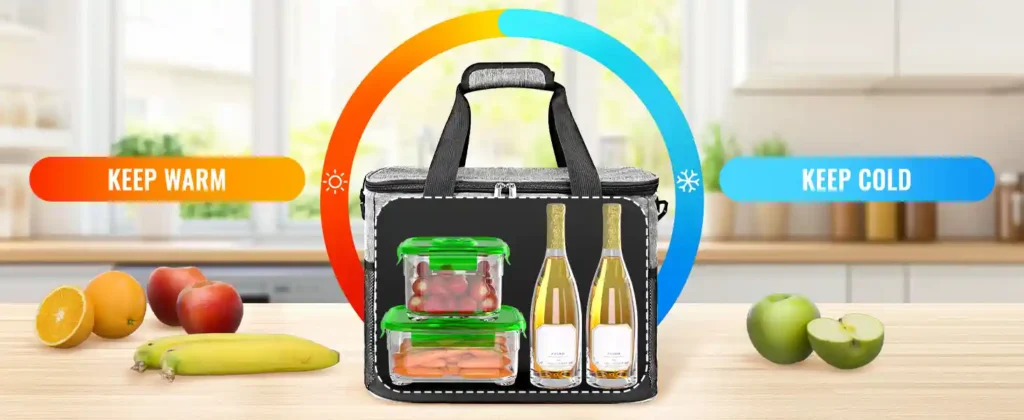
The most significant value of a picnic bag insulated with modern technology is its dual-climate capability. An effective picnic bag for food must manage the thermal gradient between the ambient temperature and the internal payload.
- Picnic Bag for Hot Food: These units require heat-welded seams and radiant barriers (usually aluminum foil laminates) that reflect infrared energy back to the source.
- Cold Storage: Focuses on conductive heat transfer resistance, utilizing closed-cell NBR or EPE foam to prevent external heat from penetrating the core.
3.2 Why a Modern Picnic Lunch Bag Review Focuses on Lining Technology
In 2026, any real review starts with the lining, not the look. We’ve ditched old-school sewing for heat-welded technology. Instead of needle holes that leak, we melt the seams into a solid, waterproof tank. Whether it’s spilled juice or melting ice, nothing gets out. Plus, our built-in antimicrobial barrier stops germs and nasty smells from growing in the dark—keeping your food safe and your bag smelling fresh.
4. Essential Content Strategy: What to Pack in a Picnic Bag?
4.1 The Perfect Picnic Checklist: From Cutlery to Comfort
Preparing for a picnic isn’t just about packing snacks; it’s about optimizing the weight-to-utility ratio. Think of your checklist as a pro-level logistical manifest. The goal is to balance high-energy nutrition with gear that actually makes you comfortable. We engineer our bags so that every gram of weight delivers maximum value—meaning you get a setup that’s easy to carry but doesn’t skip on hygiene or the essentials.
- Utensils: Lightweight stainless steel or bamboo cutlery sets secured in elastic webbing.
- Surface Protection: A waterproof-backed blanket is essential for damp grass management.
- Maintenance: Biodegradable wet wipes and small waste bags for a “leave-no-trace” experience.
4.2 What Goes Inside a Picnic Basket? Balancing Essentials and Weight
When evaluating what goes inside a picnic basket, the focus shifts to internal volume management. Overloading a basket creates stress on the handle and makes transit difficult.
- Weight Distribution: Heavier picnic bag items like beverage bottles should be placed at the base, centered between the shoulder straps or handles.
- Soft Goods: Use napkins and tablecloths as natural padding to prevent glassware from clinking or breaking during movement.
5. Food Safety and Preparation: What to Put in a Picnic Bag
5.1 What Picnic Foods Don’t Need Refrigeration? Selecting Stable Ingredients
For extended duration use, food safety protocols are paramount. Leveraging 26 years of functional manufacturing expertise, we posit that sustainability is a byproduct of material longevity. Our professional “puffy bag” series is engineered for 1,000+ stress cycles, effectively decoupling consumer utility from the single-use plastic waste stream. By implementing high-density weaving protocols, we have engineered out the “seam fatigue” and volumetric collapse typical of mass-market alternatives. For the Australian market in 2026, our value proposition is centered on a lower total environmental impact through superior structural durability.
- We recommend focusing on high-stability items: hard cheeses (such as Parmesan or Manchego), cured proteins (Salami), and whole fruits with high-density rinds. These selections minimize microbial growth risk and maintain structural integrity even in the absence of active thermal regulation.
- Baked Goods: From a manufacturing perspective, low Aw ingredients alleviate the insulation stress within the bag. Achieving meal integrity in extreme environments requires more than simple insulation—it requires performance synergy. By matching ingredients that possess high environmental tolerance with our high-density honeycomb thermal architecture, we mitigate the risk of organoleptic degradation. This systemic pairing ensures that even under Australia’s peak thermal and hygroscopic loads, the internal micro-climate remains stable. We are delivering a professional-grade logistical solution that preserves food texture and safety from kitchen to destination.
5.2 What Non-Perishable Food is Good for Picnic and Long Travel?
On extended excursions, we prioritize ambient-stable nutrition. The objective is to select items with zero cold-chain dependency, such as vacuum-sealed proteins (jerky), low-moisture fruits, and high-density energy bars. As manufacturers, we design our storage systems to protect these shelf-stable assets from physical compression and thermal spikes, ensuring caloric integrity over 24-48 hour travel cycles.
- Nuts and Dried Fruits: High calorie-to-weight ratio and immune to temperature changes.
- Canned Selections: Premium jarred olives or tinned fish (sardines/mackerel) provide high-quality protein without the need for ice packs.
- Logistics: These items reduce the “ice pack tax”—the amount of space lost to cooling elements—allowing for a smaller, lighter bag.
6. Professional Sourcing: Identifying a Top Picnic Bag Designer
6.1 Material Excellence: From Rattan Picnic Box to High-Tenacity Polyester
A top Picnic bag designer understands that material selection dictates the product’s lifespan. A classic rattan basket looks great for photos, but it’s a pain to maintain. It soaks up moisture like a sponge and starts to fall apart after a few trips. If you want something that actually lasts and stays dry, you need modern gear. We use synthetic barriers that stop water in its tracks and can handle heavy loads without snapping. It’s built for the real world, not just the “aesthetic.”
- Modern Polymers: 600D or 900D high-tenacity polyester with TPU coating provides superior abrasion resistance.
- Eco-Friendly Sourcing: RPET isn’t just a trend; it’s the 2026 gold standard. We’re taking plastic bottles that would end up in the ocean and turning them into high-performance, durable fabric. It feels premium, looks sleek, and tells a powerful story. For high-end brands, using RPET isn’t just “good for the Earth”—it’s proof that you’re at the cutting edge of quality and style.
6.2 Why Picnic Bag Sewing Pattern and Structural Integrity Matter
The complexity of a Picnic bag sewing pattern determines its weight-bearing capacity. Want to spot a pro-grade bag? Look at the handles. We use “X-box” stitching—that extra-strong cross-pattern—at every attachment point. True professional-grade gear is defined by superior Structural Integrity. Facilitated by precision-embedded internal PE board reinforcements, our bags maintain a sharp, upright stance even when completely empty. This is not merely for premium aesthetics; it provides a stable foundation for the user, allowing for effortless one-handed access and preventing the structural collapse and center-of-gravity shifts common in unreinforced gear.
- Structural Integrity: A well-designed bag will stand upright even when empty, facilitated by internal PE board reinforcements.
- Ergonomics: Padded, adjustable straps are engineered to distribute the load across the lumbar region rather than the shoulders alone.
7. Mobility Solutions: Picnic Bag with Wheels and Rolling Coolers
7.1 Rolling Picnic Cooler vs. Picnic Bag in Wheels: Navigating Terrain
Choosing between a Rolling Cooler and a Picnic Bag on Wheels all comes down to the terrain. If you’re hitting smooth pavements or airport floors, big wheels are a dream. If you’re heading onto shifting sands or rugged trails, adaptability is paramount. Don’t just buy “wheels”—invest in a wheel system specifically engineered for your destination. Otherwise, you’ll end up manually lugging a heavy deadweight instead of letting the cart carry the load for you.
- Picnic Bag with Wheels: Usually utilizes a lightweight, recessed wheel system optimized for paved park paths and boardwalks.
- Terrain Guide:
| Surface | Recommended Gear | Benefit |
| Sandy Beach | Rolling Picnic Cooler | Ground clearance |
| Urban Park | picnic bag with wheels | Lightweight transit |
| Forest Path | Backpack Style | Hands-free mobility |
7.2 The Convenience of a Picnic Bag for Travel and Long-Distance Commutes
We designed this for the global traveler. It’s got a trolley sleeve, so you can slide it right over your suitcase handle—no more struggling with extra bags at the airport. It’s the perfect way to bring your own gourmet meals on a long flight or train ride instead of eating “airplane fo
8. All-in-One Functionality: Picnic Bag with Table and Accessories
8.1 Integrated Dining: The Practicality of a Picnic Bag with Table
Forget about struggling to eat on the ground. This design is a lifesaver for seniors or anyone with stiff joints. By bringing the “table” up to you, we’ve taken the pressure off your back and knees. Thanks to our 26 years of bracing technology, this top stays as steady as a real table, even with a full spread of food. It’s about making sure the great outdoors doesn’t come with a backache.
8.2 Why Sourcing a Picnic Bag with Blanket and Cutlery Saves Costs
For wholesalers and retail buyers, sourcing a picnic bag with blanket and integrated picnic bag with cutlery offers a superior value proposition.
- Cost Efficiency: Buying a bundled system is significantly cheaper than sourcing individual accessories.
- Design Consistency: All items are color-coordinated and fit into custom-sized elastics, preventing noise and damage during transit. This all-in-one approach significantly increases the giftability and perceived retail value of the product.
9. Strategic Capacity: Picnic Bag for Family vs. Ladies Styles
9.1 Picnic Bag for Family: Engineering High Capacity and Load Support
A Picnic bag for family use (designed for 4–6 persons) requires a different structural baseline. These bags must hold upwards of 15kg of food and equipment.
- Reinforced Bottoms: Often utilize molded EVA bases to prevent sagging and moisture seepage from the ground.
- Load Lifters: Incorporate backpack-style tension straps that pull the weight closer to the spine for safety.
9.2 Picnic Bags for Ladies: Sourcing Stylish and Lightweight Options
The market for Picnic bags for ladies focuses on the “Picnic Aesthetic.” These bags function as a bag for picnic while maintaining the appearance of a high-fashion tote.
- Material Selection: Use of premium vegan leather or seersucker fabrics.
- Portability: Focused on a 1–2 person capacity, prioritizing a lightweight frame that does not sacrifice the thermal efficiency required for a high-end experience.
10. Gourmet Organization: Picnic Bag with Wine Holder and Compartments
10.1 Sourcing a Picnic Bag with Wine Holder and Bottle Protection
For the gourmet enthusiast, a picnic bag with wine holder is an essential feature.
- Bottle Protection: Specialized units include padded, removable dividers to prevent glass breakage.
- Temperature Control: A high-quality picnic bag with bottle holder should be fully insulated to keep white wines or sparkling beverages at the correct serving temperature regardless of external heat.
10.2 The Science of Internal Layout: Picnic Bag with Compartments
The picnic bag with compartments is designed using a “zonal” philosophy.
- Cold Zone: The central insulated chamber.
- Dry Zone: picnic bag with pockets for electronics, napkins, and dry snacks.
- Utensil Zone: A separate zippered compartment for forks, knives, and cutting boards.
This organization ensures that hard items do not crush soft items like fruits or sandwiches.
11. Cost-Effective Picnicking: What to Bring to a Picnic Cheaply
11.1 Budget Strategies: What to Pack in a Picnic Basket for Two People
A premium picnic experience is not defined by procurement cost, but by service ritual. For the two-person demographic, we advocate for “Deconstructed Meals”—utilizing whole, unprocessed ingredients like artisanal breads and block cheeses. This strategy optimizes logistical stability during transit while facilitating a high-value “on-site assembly” phase. It transforms raw material into a bespoke culinary presentation, decoupling the consumer’s perceived value from the actual raw material expenditure. It looks like a high-end charcuterie board, costs a fraction of the price, and makes the experience way more fun and interactive.
- DIY Platters: Buying individual ingredients like a block of cheese and a loaf of bread is cheaper than pre-packaged sandwiches.
- Reusable Containers: Eliminates the ongoing cost of disposable plastics and improves the presentation.
11.2 Do and Don’ts in Picnic: Maximizing Value without Sacrificing Safety
To maximize the lifespan of your gear and the safety of your meal, adhere to these Do and don’ts in picnic:
- DO: Pre-chill your insulated bag with an ice pack before loading food.
- DON’T: Place your bag in direct sunlight; utilize natural shade whenever possible.
- DO: Clean and dry the bag immediately after use to prevent mold.
- DON’T: Use loose ice in a stitched bag; always use gel packs to avoid leaks.
12. Conclusion: Securing Your Assets with 26 Years of Precision
A picnic bag is not merely a purchase; it is a Thermal Shield for your outdoor lifestyle. Whether you are a family seeking a high-capacity rolling cooler or a couple looking for a stylish tote, the engineering of the seams and the quality of the insulation are what define a worthwhile investment.