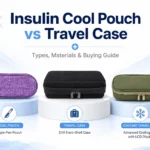
1. What Is An Insulin Cooler?
Stashing your diabetes meds in just any old bag won’t cut it—an insulin cooler is a serious medical-grade case built to shield heat-sensitive drugs from brutal weather swings. Unlike your average lunch tote, a real insulin cooler travel case relies on high-tech phase-change materials, vacuum insulation, or active chilling units to lock in that crucial 2°C to 8°C clinical window required by the FDA and NHS.
If you’re on the manufacturing end, you’ve got to weigh these strict medical specs against standard lunch bags, figure out if you’re building active tech or just a basic thermal wrap, and map out storage for both opened and unopened supplies. Otherwise, you’re looking at some pretty pricey design hiccups once production is already rolling.
-
Primary Function: Protects heat-sensitive diabetes medications from extreme temperature fluctuations during daily transit.
-
Core Technology: Integrates phase-change materials, vacuum insulation, or active refrigeration systems.
-
Key Considerations: Requires evaluating structural boundaries, comparing with ordinary lunch bags, and managing opened versus unopened storage parameters.

2. How Does An Insulin Cooler Work?
Thermal regulation devices rely on diverse scientific principles to delay or counteract ambient heat transfer into the internal medication storage chamber. Tossing an insulin cooler travel case into your bag means you’re trusting some serious engineering to fight off brutal summer heat with thick polyurethane or vacuum insulation. To keep that safe temperature window locked down without accidentally freezing your meds, these packs mix heavy-duty thermal lining with handy extras like phase-change packs, cooling gel, or a USB-powered chip. Honestly, slipping your gear into a dependable insulin travel case cooler takes all the stress out of heading out the door, making sure your life-saving medication stays safe and stable no matter where you end up.
-
Thermal Barriers: High-density polyurethane and vacuum insulation panels block conduction, convection, and radiation.
-
Cooling Mechanisms: Utilizes phase-change materials, gel ice packs, evaporative cooling pouches, and USB-powered modules.
-
Stabilization: Prevents freezing or overheating to maintain internal pharmaceutical safety.

3. Main Types of Insulin Cooler Travel Cases
OEM manufacturing operations produce diverse container formats tailored to specific patient lifestyles, travel durations, and clinical regulatory requirements. When building an insulin cooler travel case, choosing the right structure is everything. Soft insulated bags with flexible fabrics and EPE foam are great for everyday commutes, while EVA hard-shell cases are a lifesaver for protecting fragile glass vials from getting crushed in your bag.
Beyond that, you’ve got plenty of options to match your lifestyle: water-activated cooling pouches keep things simple with electricity-free evaporation, sleek vacuum bottle coolers handle long-haul intercontinental flights, and powered electric coolers use smart USB semiconductor chips for exact digital temperature management. Whether you’re heading across town or around the world, finding the right insulin travel cooler makes all the difference in keeping your medication safe and steady.
| Cooler Type | Core Construction Material | Primary Use Case & Advantage |
| Soft Insulated Bags | Flexible textiles & EPE foam | Lightweight daily commuter use |
| EVA Hard-Shell Cases | Molded ethylene-vinyl acetate | Crush protection for fragile glass vials |
| Water-Activated Pouches | Evaporative fabric layers | Electricity-free emergency or outdoor use |
| Vacuum Bottle Coolers | Double-wall stainless steel | Extended intercontinental travel |
| Electric Refrigerated Coolers | USB-powered semiconductor chips | Precise active digital temperature control |

4. How to Choose The Right Insulin Travel Cooler
Selecting appropriate thermal storage units requires analyzing several interrelated environmental, physiological, and logistical variables. Sourcing managers and brand owners evaluating any insulin cool pouch and travel case must review certified laboratory cooling durations, pen and vial capacity, regional ambient temperatures, user access to freezers or electricity, device portability, digital temperature displays, and waterproof condensation control to ensure uninterrupted medication protection during transit.
-
Performance Metrics: Evaluates certified laboratory cooling durations and ambient temperature extremes.
-
Capacity Needs: Accounts for pre-filled injection pens, glass vials, or backup cartridges.
-
Logistical Factors: Assesses access to freezers/electricity, portability, weight, temperature displays, and leak control.

5. Insulin Cooler Travel Case With Temperature Display
An advanced insulin cooler travel case equipped with digital monitoring features provides enhanced clinical safety and operational peace of mind for traveling patients. Real-time temperature displays allow users to verify internal thermal stability instantly without opening the container, outperforming passive data loggers by offering immediate visual feedback, provided that precision thermistor sensors are accurately positioned adjacent to medication storage slots to handle extreme climate fluctuations.
-
Real-Time Monitoring: Allows instant thermal verification without opening the protective container.
-
Display vs. Data Logger: Provides immediate visual feedback for daily use compared to historical compliance logging.
-
Sensor Accuracy: Requires precise thermistor placement adjacent to storage slots for exact air temperature readings.

6. Common Mistakes When Using An Insulin Cooler Travel Case
Patient misuse can compromise thermal storage performance and expose sensitive medications to dangerous temperature deviations. Common operational errors when handling an insulin cooler include placing medications in direct contact with uninsulated frozen packs which freezes and ruins the protein structure, assuming colder environments are always safer, overpacking or underpacking internal chambers, leaving coolers inside parked vehicles with extreme solar heat, and ignoring manufacturer pharmaceutical packaging inserts regarding specific temperature limits.
-
Direct Contact Hazards: Placing drugs against uninsulated frozen packs destroys protein structures via freezing.
-
Temperature Misconceptions: Assuming sub-zero freezing is safer than heat exposure damages medications.
-
Packing & Environmental Errors: Overpacking limits airflow, while leaving devices in parked vehicles overwhelms thermal boundaries.
7. Materials Used In A Portable Insulin Cooler
Getting a portable insulin cooler ready for mass production means nailing your materials from day one. You want a tough outer shell—like rugged 600D or 900D polyester Oxford or a sleek molded EVA case—backed by a middle layer of closed-cell EPE foam to stop heat dead in its tracks. On the inside, waterproof TPU and PEVA, or foil linings keep everything clean and dry, while custom gel packs, phase-change packs, heavy-duty coil zippers, and elastic straps lock all your medical gear safely in place.
-
Outer Shells: 600D/900D polyester or molded EVA hard shells for abrasion and impact resistance.
-
Insulation Layers: EPE closed-cell foam blocks thermal conduction across container walls.
-
Liners & Hardware: PEVA, TPU, or aluminum foil inner linings paired with heavy-duty zippers and elastic retainers.
8. B2B Buyer’s Checklist for Custom Insulin Cooler Bags
Sourcing managers stick to a pretty strict checklist when vetting factory bids and locking down custom production runs. If you’re hunting for a dependable insulin cooler to sell or manufacture, you’ve got to lock down your exact temperature targets and sizing right from day one. You’ll want to demand lab reports proving it actually survives real-world stress, and make sure every single material clears FDA, LFGB, REACH, and RoHS hurdles without a hitch.
Honestly, everything matters down the line—from nailing your custom logo placement and signing off on that final pre-production sample to hammering out reasonable MOQs and setting rock-solid AQL inspection rules before mass production kicks off. Whether you’re ordering a rugged insulin cooling case or a full bulk line, ticking every box upfront keeps your supply chain running smoothly.
| Checklist Parameter | Buyer Specification Requirement |
| Clinical & Thermal Specs | Define target temperature range (2°C–8°C) and transit duration |
| Layout & Capacity | Specify pen slots, vial holders, and accessory pockets |
| Testing & Compliance | Request lab test reports and verify FDA, LFGB, REACH, and RoHS standards |
| Production & Quality | Confirm logo methods, pre-production golden samples, MOQ, and AQL standards |
9. Frequently Asked Questions About Insulin Cooler Travel Case
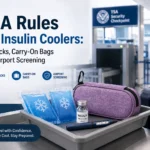
A reliable insulin cooler holds that critical 2°C to 8°C safety zone anywhere from 12 to 72 hours, depending on the weather and the size of your ice packs. Just remember to keep medication from touching bare ice directly so the insulin doesn’t freeze and ruin. Just remember that if you go with an active cooler, you’ll need to keep it charged up. You’ll also want to give security a heads-up at TSA checkpoints, and definitely pick an insulin travel case cooler with enough room for whatever you carry—whether that’s just a couple of pens or a handful of glass vials. Learning how to keep insulin cool while traveling before every going out can save you a lot of trouble.
-
Cooling Duration: Maintains 2°C to 8°C for 12 to 72 hours based on conditions and refrigerant mass.
-
Safety Rules: Avoid direct contact with uninsulated ice packs; declare supplies at TSA checkpoints – TSA approved insulin cooler may be a great design.
-
Device Options: Choose between active/refrigerated units and specific formats optimized for pens or glass vials.