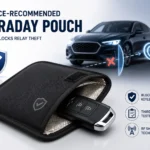
1. Which Faraday Pouches Actually Work? Start With Performance, Not Marketing Claims
At the end of the day, real Faraday pouches only function properly when they use multi-layer metallic shielding fabric engineered to block electromagnetic fields across specific radio frequencies—going far beyond simple RFID protection. That is precisely why consumers constantly wonder which Faraday pouches actually work, especially when they are flooded with conflicting marketing promises of total signal isolation that lack any real lab test data to back them up.
To pick the best Faraday bag, you’ll want to review supported frequency ranges, inspect seam construction, pick the right size, and demand real lab test data. Procurement pros need to team up with experienced Faraday bag manufacturers who run strict quality control checks throughout every single production batch.
- RFID vs. Full Faraday Isolation: Basic RFID blocking only stops low-frequency cards and tags, whereas true Faraday shielding kills cellular, Wi-Fi, and GPS signals completely.
- Performance Metrics: Solid products come with actual attenuation charts backed by decibel (dB) measurements across everyday radio bands.
- Use-Case Definition: Specs don’t mean much unless the bag is actually matched to the specific device you’re carrying and the threat you’re trying to block.

2. What Signals Should a Good Faraday Pouch Block?
For maximum performance, a solid Faraday pouch has to wipe out signals across the whole board—from cellular and Wi-Fi to Bluetooth and GPS. Doing Faraday bag signal blocking right shuts down all those wireless channels completely, keeping your private data locked down and stopping remote hackers in their tracks. Since cellular signals bounce between low and mid-band ranges, the pouch needs dense conductive mesh to completely cut off those towers.
Furthermore, Wi-Fi and Bluetooth protocols use 2.4 GHz and 5 GHz bands that bleed through standard fabric if the shielding isn’t up to snuff. Even GPS signals, which operate on higher microwave frequencies, require multi-layer protection to stop people from tracking your location. Because of these technical differences, you really have to distinguish between basic RFID sleeves and full-spectrum isolation if you want to know which Faraday pouches actually work. Without a reliable Faraday bag signal blocking test, it is all too easy to mistake a simple credit card protector for a real security solution.
-
Cellular Isolation: Blocking low-band, mid-band, and high-band cellular communication frequencies.
-
Wireless Blocking: Comprehensive attenuation of 2.4 GHz and 5 GHz Wi-Fi and Bluetooth transmission protocols.
-
GPS Shielding: Effective interception of microwave satellite tracking signals to ensure absolute user location privacy.

3. How to Test a Faraday Bag at Home
Conducting a how to test a Faraday bag verification process at home requires systematic empirical checks using cellular data, Wi-Fi networks, Bluetooth pairings, and vehicle key fob proximity responses. Simply placing a phone inside a pouch and calling it does not confirm shielding effectiveness across all frequency bands because modern phones often use multiple antenna systems. A professional approach involves testing whether the device can successfully maintain a data connection through Wi-Fi or Bluetooth while inside the bag. Testing against vehicle keyless ignition systems provides a clear, binary indicator of low-frequency signal isolation performance. These methods offer a reliable practical evaluation before deploying equipment in high-security environments.
- Cellular & Data: Check whether both voice calls and mobile data packets are completely neutralized.
- Wi-Fi Connection: Drop a phone inside and check that its active wireless connection goes completely dead on the spot.
- Bluetooth Pairing: Make sure any active pairing to wireless headphones or speakers cuts out instantly.
- Vehicle Key Fob: Stand right next to your car with the fob tucked inside—the doors should stay locked and the engine won’t even crank.

4. How Professional Faraday Bag Testing Works
When you want to see which Faraday pouches actually work, you can’t just rely on guesswork. Instead, top-tier testing labs put them through a rigorous Faraday bag signal blocking test inside specialized anechoic chambers. Engineers then use calibrated spectrum analyzers to measure down to the exact decibel how much signal the bag kills across real-world frequencies.
Lab engineers blast finished samples with RF generators to measure real-world shielding before giving green lights for production. Testing the complete bag matters way more than just checking raw fabric, since sketchy seams and closures love to leak signals. B2B buyers need to demand full test reports showing actual attenuation curves across cellular, Wi-Fi, and GPS bands. For buyers evaluating a police recommended Faraday pouch, independent test data matters more than endorsement claims, because measurable attenuation is what proves real-world shielding performance. Locking in strict decibel benchmarks keeps your mass-production batches consistently bulletproof.
-
Anechoic Chamber Analysis: Precision laboratory measurement of signal attenuation using calibrated spectrum analyzers.
-
Finished Product Evaluation: Validating complete manufactured bags to account for seam and closure leakage points.
-
Decibel Verification: Reviewing standardized attenuation curves across multi-band radio frequency spectrums.

5. Why Do Some Faraday Pouches Stop Working?
Faraday pouches stop working when internal shielding fabrics suffer mechanical abrasion, microscopic crease cracking, or oxidative degradation over extended periods of daily use. Users asking do Faraday bags work often fail to realize that physical wear reduces conductive pathways embedded within the textile layers. Signal leakage frequently occurs around improperly designed hook-and-loop closures or magnetic seals where electrical continuity is compromised through persistent mechanical stress. Incorrect device placement or failing to fold closure flaps completely allows ambient radio frequency waves to penetrate the internal storage compartment during transit. Engineering reinforced seam constructions and durable multi-layer closures is essential for extending the operational lifecycle of signal-blocking products.
-
Damaged Shielding Fabric: Mechanical abrasion from daily use degrades conductive metallic threads within the textile layers.
-
Closure Leakage: Incomplete sealing or worn fastener mechanisms allow electromagnetic waves to enter storage areas.
-
Daily Wear: Persistent creasing, folding, and abrasion break down shielding integrity over extended usage periods.
Aimazing Bag addresses these risks with a durable 4-layer shielding structure, reinforced construction, and stable signal-blocking performance tested through 8 million uses. With up to 106 dB attenuation, our Faraday Pouch exceeds the 100 dB military-level benchmark for long-term reliability.

6. Is a Faraday Bag Worth It? It Depends on What You Need to Protect
Faraday bags provide immense value when securing vehicle keyless entry fobs, mobile phone privacy, and sensitive electronics against electromagnetic interference. Vehicle owners utilizing smart key systems face significant relay attack risks that are entirely neutralized by utilizing dedicated signal-blocking storage containers. Privacy-conscious individuals and corporate executives rely on advanced signal isolation to prevent unauthorized remote activation and data harvesting. Basic RFID sleeves remain sufficient for protecting contactless payment cards, whereas full Faraday protection is mandatory for comprehensive device isolation. Evaluating specific threat models dictates the level of shielding investment required for your unique security requirements.
| Use Case | Protection Level | Full Faraday Needed? |
| Keyless Car Fobs | High-attenuation isolation | Yes, prevents relay theft |
| Mobile Phones | Multi-frequency RF containment | Yes, prevents tracking |
| Contactless Cards | Basic RFID/NFC blocking | No, simple sleeves are sufficient |

7. What Are the Disadvantages of Faraday Bags?
Look, using Faraday pouches isn’t all sunshine and rainbows—you’re signing up for a total blackout on your gear, dealing with shielding that wears down over time, and taking a hit on daily convenience. Let’s be real: locking down that level of security means you’ve got to give up the ease of grabbing your phone or unlocking your keys on the fly. For travelers, understanding does TSA allow Faraday bags also helps clarify when signal-blocking security may create extra airport screening steps.
Furthermore, if you want to know which Faraday pouches actually work long-term, you cannot just set it and forget it—you have to run periodic checks to make sure daily folding and wear haven’t ruined the conductive fabric. Ultimately, balancing ironclad electromagnetic security with daily usability takes some seriously smart product engineering and clear-eyed expectations.
-
Communication Blackout: Enclosed electronic devices cannot receive calls, messages, or network data packets.
-
Performance Degradation: Continuous physical wear and folding can gradually reduce signal attenuation effectiveness.
-
Convenience Trade-off: Enhanced security requires manual removal of electronic devices for standard daily operation.
8. How to Choose the Best Faraday Bag: A Buyer and OEM Sourcing Checklist
Choosing the best Faraday bag Checking supported frequency ranges, inspecting seam construction, picking the right size, and demanding real laboratory test data. Procurement pros need to team up with experienced manufacturers who run strict quality control checks throughout every single production batch. Verifying that closure systems maintain continuous electrical conductivity prevents common signal leakage vulnerabilities often found in inferior retail alternatives. Establishing clear technical specifications for fabric weight, padding, and outer shells ensures the optimal balance between protection and durability. Direct partnerships with experienced factories guarantee uncompromised manufacturing standards for custom branded security collections.
-
Frequency Range: Making sure you’re getting heavy-duty attenuation across cellular, Wi-Fi, and GPS bands instead of settling for basic RFID blocking.
-
Seam Construction: Checking that the seams feature continuous conductive stitching and robust multi-layer closures so stray signals can’t sneak out.
-
Test Data: Demanding actual, product-specific lab attenuation reports to back up your sourcing moves before signing off on bulk orders. order.
9. Frequently Asked Questions (FAQ)
-
Which Faraday pouches actually work?
The Faraday pouches that actually work use continuous multi-layer conductive shielding, secure closures, and verified attenuation across the frequencies they claim to block. A reliable pouch should isolate more than RFID—it should prevent cellular, Wi-Fi, Bluetooth, and GPS communication when designed for full-spectrum protection. Look for product-specific test data, strong seam construction, and consistent performance after repeated opening and folding. Aimazing Bag specifies a 4-layer shielding structure with attenuation up to 106 dB and stable signal-blocking performance after 8 million uses.
-
How can I test if a Faraday bag really works?
The best way to test a Faraday bag at home is to check several wireless connections rather than relying on one phone call. Place the device inside, fully close the pouch, then test cellular calls and mobile data, Wi-Fi connectivity, Bluetooth pairing, and GPS-related functions. For a key fob pouch, place the key inside and try unlocking or starting the vehicle nearby. If any intended signal still works consistently, inspect the closure and device placement before assuming the shielding itself has failed.
-
Do Faraday bags block cellular, Wi-Fi, Bluetooth, and GPS?
Yes, a properly designed full-spectrum Faraday bag should significantly attenuate cellular, Wi-Fi, Bluetooth, and GPS signals when the device is completely enclosed. These wireless systems operate across different frequency bands, so blocking one signal does not automatically prove that every other band is isolated. This is why a simple RFID sleeve should not be treated as a full Faraday pouch. Buyers should confirm the supported frequency range and review attenuation test data rather than relying only on broad “signal blocking” marketing claims.
-
Why do Faraday pouches stop working over time?
Faraday pouches can stop working when shielding fabric, seams, or closures deteriorate enough to create signal-leakage paths. Repeated folding, abrasion, creasing, and oxidation may reduce the conductivity of metallic shielding layers, while worn hook-and-loop or poorly sealed closures can interrupt the continuous Faraday enclosure. Regular testing is therefore important for products used every day. Aimazing Bag addresses these durability risks with reinforced construction and a 4-layer shielding structure designed to maintain stable signal-blocking performance through repeated use.
-
Is a Faraday bag worth it?
Yes, a Faraday bag is worth it when you need reliable wireless isolation for devices such as keyless car fobs, smartphones, or sensitive electronics. It can help prevent key-fob relay communication and isolate phones from cellular, Wi-Fi, Bluetooth, and GPS connections while properly sealed. However, the required protection depends on the use case. If you only need to protect contactless payment cards from RFID or NFC scanning, a basic RFID sleeve may be sufficient, making a full-spectrum Faraday pouch unnecessary.
-
Can I wash a Faraday bag?
Never throw it in the washing machine or soak it, as water and tumbling destroy the conductive fibers. If it gets dirty, spot-clean the exterior with a dry or slightly damp cloth while keeping moisture completely away from the interior lining.